It’s a staple in every kitchen, a foundational flavor across global cuisines, and the “King of Spices” for a reason. Black pepper, the unassuming peppercorn, is now at the heart of a burgeoning market poised for significant expansion.
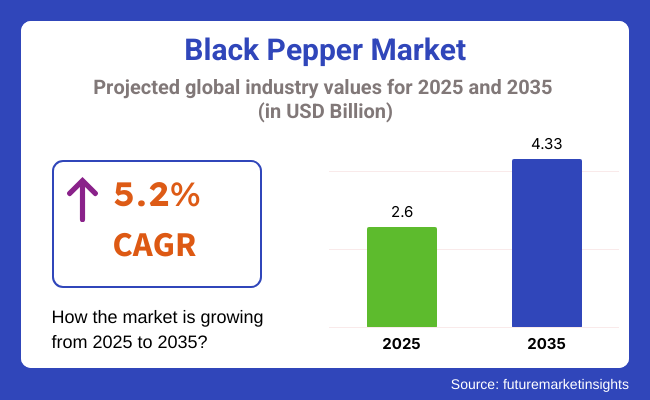
Future Market Insights projects the global black pepper market to reach a value of USD 2.6 billion by 2025 and soar to USD 4.33 billion by 2035, reflecting a robust compound annual growth rate of 5.2% over the assessment period. This isn’t just about culinary tradition; it’s a profound economic story, driven by global demand for natural flavors and the relentless expansion of the food and beverage industry. But as a journalist who has spent 15 years dissecting the true cost of our commodities
I must ask: does this seemingly innocuous spice come with a hidden baggage of complexities that we, the consumers, are simply choosing to ignore?
Get Ahead of Market Shifts: Request Your Sample Report: https://www.futuremarketinsights.com/reports/sample/rep-gb-1274
The Relentless Grind of Global Demand
The appeal of black pepper is universal. Its pungent flavor profile enhances everything from savory stews to delicate gourmet dishes, and its versatility ensures its place in kitchens worldwide. Future Market Insights attributes this robust growth to the increasing consumer demand for natural, authentic flavors and the expanding use of black pepper in the processed food sector. From ready-to-eat meals to innovative snack foods, manufacturers are integrating black pepper in myriad ways, leveraging its inherent appeal and its perceived “clean label” status compared to artificial alternatives.
The market intelligence firm highlights several key dynamics. The United States, with its ingrained culinary traditions and robust food industry, already stands out as a major consumer. However, the true engines of future growth, as identified by Future Market Insights, are emerging economies. India and China are poised to be the fastest-growing countries, each projected to accelerate at an impressive CAGR of 5.1% over the same period. This rapid acceleration is fueled by increasing health consciousness among growing middle-class populations, coupled with the globalization of diverse culinary trends. Essentially, more people with more disposable income are seeking flavorful, globally inspired food, and black pepper is at the heart of it. It’s a profitable picture, without question.
Growing Need for Market Insights: Access Our Full Report for Thorough Analysis and Trends: https://www.futuremarketinsights.com/reports/black-pepper-market
The Unseen Scar: Environmental Burden of the “King of Spices”
Yet, the ascent of black pepper to a multi-billion dollar industry is not without its significant shadows, even if Future Market Insights doesn’t explicitly quantify every single one. While Future Market Insights touches upon an “increased focus on sustainability” as a trend for the broader food industry, the inherent resource demands of large-scale spice cultivation cannot be overlooked. The intensive farming methods needed to meet rising demand, whether for black pepper or any other agricultural commodity at this scale, inevitably put pressure on land and natural resources. This is the inconvenient truth that seldom makes it onto packaging labels. The pursuit of higher yields often means substantial land use, and with increasing global demand comes implicit pressure on agricultural ecosystems.
The Human Cost: A Pungent Reality of Supply Chains
Beyond the environmental impact, the black pepper market, like many global agricultural commodities, faces inherent complexities within its supply chains. Future Market Insights points to “market opportunities” and “expanding production,” which inherently implies a vast network of cultivators and intermediaries. While the report focuses on economic drivers and product innovation, it suggests a large, intricate supply network. The challenges inherent in managing such widespread agricultural production, especially concerning fair practices and consistent quality across numerous small producers, are a common thread in global commodity markets. The journey of that peppercorn, from a remote farm to our seasoning, is often more complex than consumers realize.
The “clean label” trend, a powerful force driving consumer choice, feels particularly fraught when applied to a global commodity like black pepper. Consumers are seeking transparency, purity, and minimal processing. Future Market Insights identifies “clean label” and “natural ingredients” as key market drivers. Yet, the process of bringing a global spice from farm to table, even if it’s a ‘natural’ product, involves complex logistics, processing, and distribution networks. Are consumers truly engaging with this complexity, or are they simply reassured by the “natural” origin of the spice, overlooking the intricacies of its vast supply chain and potential resource impacts that such massive demand creates? My experience tells me many are still in the dark.
Beyond the Billions: A Demand for Authentic Stewardship
The global black pepper market, as meticulously detailed by Future Market Insights, is undeniably poised for impressive growth, driven by an ever-increasing appetite for flavor and natural ingredients. But the responsibility now falls squarely on the industry to move beyond simply quoting market figures and to truly embrace genuine accountability.
“Natural” must encompass not just the ingredient itself, but the entire process of its cultivation and sourcing, including how that sourcing impacts resources and communities. “Sustainable” cannot be a mere buzzword; it must translate into verifiable practices that protect ecosystems and ensure fair livelihoods for the farmers who cultivate this valuable spice. Future Market Insights notes that an “increased focus on sustainability” is an emerging trend for market participants, suggesting this is a path the industry needs to follow, not one fully realized. Consumers are increasingly discerning, looking beyond the immediate sensory experience to the broader impact of their choices. If the black pepper market is to truly maintain its long-held “King of Spices” title, it must demonstrate not only its economic might but also its unwavering commitment to transparent and responsible practices throughout its supply chain. Otherwise, this booming market might just leave a lingering, bitter taste of complicity. Demand more than just growth; demand integrity.
Leading Manufacturers
- Baria Pepper
- The British Pepper & Spice Co. Ltd.
- Catch
- Everest Spices
- McCormick
- MDH
- Agri-food Pacific
- Gupta Trading
- Pacific Production
- Silk Road Spices
- The Spice House
- Webb James
- Olam International Limited
- Kancor Ingredients Ltd.
- Ajinomoto Co. Inc.
- doTERRA International
 Explore Grains, Pulses & Legumes Industry Analysis: https://www.futuremarketinsights.com/industry-analysis/grains-pulses-and-legumes
Key Segments of the Report
By Nature:
This segment is further categorized into organic and conventional.
By Form:
This segment is further categorized into Whole, Ground, and Crushed.
By End Use:
As per end use, the ecosystem has been categorized into Industrial, Food Service Provider, and Retail/household.
By Distribution Channel:
This segment is further categorized into B2B and B2C.
By Region:
Industry analysis has been carried out in key countries of North America, Latin America, Europe, East Asia, South Asia, Oceania, and the Middle East & Africa.