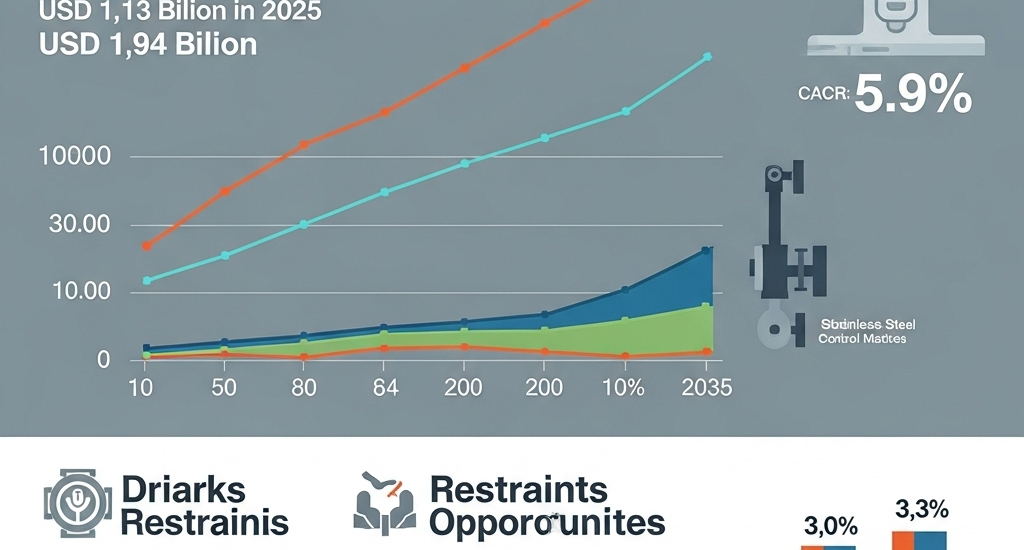
The global stainless steel control valve market is projected to expand from USD 1.13 billion in 2025 to USD 1.94 billion by 2035, reflecting a steady CAGR of 5.9% over the forecast period. Growth is primarily driven by the rising demand for durable, corrosion-resistant valves in sectors such as oil and gas, water treatment, power generation, and chemicals. North America remains a dominant market due to early adoption of automation, while Asia Pacific-led by China and South Korea-is rapidly gaining ground due to industrial expansion and infrastructure investments.
Stainless steel control valves are the unsung heroes of modern industry. They regulate flow in oil pipelines, chemical plants, water treatment systems — even food processing lines. When they fail, things don’t just leak. They explode, contaminate, shut down. And yet, American infrastructure still leans on outdated, corrosion-prone systems from the last century.
Gain Valuable Insights from Industry Experts to Shape Your Growth Strategies. Access our Sample Report Now: https://www.futuremarketinsights.com/reports/sample/rep-gb-17458
The Price of Hesitation
Let’s be honest: stainless steel isn’t cheap. Especially not the 316 and duplex grades required to resist aggressive media and extreme temperatures. But here’s the truth — that cost is justified. You’re not just buying a component; you’re buying uptime, safety, and reliability.
Still, many mid-size operators hesitate. According to FMI, the high cost of materials and compliance is forcing smaller players to delay upgrades, patch old systems, or settle for inferior materials. It’s short-sighted. And ultimately, it’s more expensive.
A Broken Incentive System
The U.S. doesn’t lack the technology. It lacks the will. While Europe pushes forward with advanced actuator integration and Asia builds automation into its industrial DNA, America is stuck in its own red tape. No bold national initiative to modernize process infrastructure. No meaningful incentives to switch to low-emission, high-integrity flow control systems.
This isn’t a gap — it’s a gaping hole.
FMI points to automation and environmental compliance as key drivers of demand. But these drivers require coordination, policy, and leadership. We’re not seeing enough of any.
Browse full Report Here: https://www.futuremarketinsights.com/reports/stainless-steel-control-valve-market
What the Market Is Telling Us
There’s no mystery here. The market’s direction is crystal clear.
- Automation is rising. Stainless steel valves are the backbone of smart systems that demand precision and reliability.
- Electric actuators are winning. They’re clean, controllable, and increasingly standard in next-gen plants.
- Environmental scrutiny is tightening. Leakproof, long-life valves are now table stakes — not nice-to-haves.
FMI’s analysis confirms it: industrial buyers are shifting toward stainless steel not out of preference, but out of necessity. Harsh environments, corrosive fluids, volatile processes — these demand equipment that doesn’t flinch.
Time for a Wake-Up Call
The U.S. has a decision to make. Stick with aging infrastructure patched with stopgap repairs? Or invest in the stainless steel future already being built in Germany, South Korea, and the Gulf?
The market is moving on. If we’re not careful, we’ll find ourselves buying stainless steel valves — and the expertise to install them — from abroad, at a premium.
We’ve done it before with semiconductors. Let’s not repeat the mistake with industrial automation.
Latest Automation Auxiliary Reports: https://www.futuremarketinsights.com/industry-analysis/automation-auxiliary
Final Word
Stainless steel control valves may sound like an obscure niche. They’re not. They are foundational to the systems that keep our water clean, our factories productive, and our energy secure.
Ignore them, and we’ll pay in failures, emissions, and lost ground to faster-moving economies.
The future is flowing fast. Either we invest in stainless steel control — or lose control altogether.