Polyvinyl chloride — PVC, to most of the world — is everywhere. In your plumbing. Your electrical insulation. Your window frames. Even in your credit cards. And yet, for a material so embedded in modern life, PVC is entering a period of intense scrutiny and reinvention.
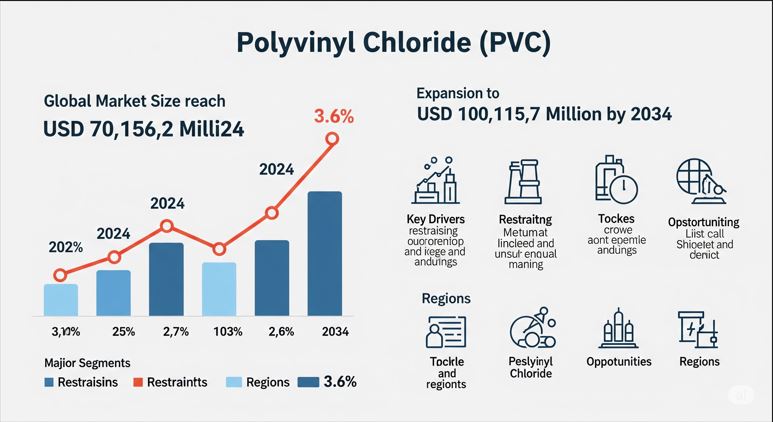
The Polyvinyl Chloride Market, as reported by Future Market Insights, is projected to reach a valuation of USD 105.4 billion by 2033, growing at a modest CAGR of 3.8% from USD 72.3 billion in 2023.
On paper, that looks like stable growth. But stability masks the storm brewing underneath.
The Plastic Paradox
PVC is the poster child of industrial versatility — cheap to make, easy to mold, highly durable. It has enabled the explosion of low-cost housing, safe medical tubing, and reliable power grids. But let’s face it — it’s also one of the most controversial plastics ever created.
The problem isn’t just its fossil fuel origin or its chlorine base — it’s what happens after use. Unlike polyethylene or polypropylene, PVC is notoriously difficult to recycle. When incinerated, it releases dioxins — some of the most toxic substances known to science. When landfilled, it lingers. For decades.
And yet, the market grows. Why?
Because we’ve built entire industries around it. And because the alternatives, for now, are either too costly, too weak, or too niche.
Request Report Sample: https://www.futuremarketinsights.com/reports/sample/rep-gb-152
Demand from the Developing World
While the West begins to flirt with green alternatives, emerging economies are doubling down on PVC. Southeast Asia, Latin America, and Africa are investing heavily in infrastructure — and PVC remains their go-to polymer. It’s affordable. It’s functional. It works.
But here’s the catch: that growth is accelerating at a time when the global climate narrative is shifting. Governments are cracking down on emissions, brands are pledging circularity, and consumers are increasingly suspicious of anything labeled “plastic.”
PVC, the old industrial workhorse, is being asked to fit into a new sustainability box. It doesn’t — not yet.
Is There a Green PVC?
This is where the future of the market hangs in the balance.
Producers are exploring bio-attributed PVC, waste-derived feedstocks, and closed-loop recycling systems. Some early pilots show promise. But scale? Still years away. Regulatory guidance? Murky at best. And investor enthusiasm? Tepid, unless it’s greenwashed.
The real turning point will come when policy meets innovation. If regulations tighten around high-chlorine plastics — as they likely will in Europe and North America — traditional PVC could face a contraction. On the other hand, if producers manage to crack circularity and carbon neutrality, PVC might just find a second life as a “next-gen” material.
What the Industry Needs to Hear
Enough with the passive optimism. The PVC sector needs to confront three hard truths:
-
Cheap won’t cut it forever. Price competitiveness isn’t enough when environmental costs are unaccounted for.
-
The circular economy isn’t a buzzword. It’s a necessity, and right now, PVC is failing that test.
-
Greenwashing is dangerous. Claiming recyclability while exporting waste to the Global South is not a strategy — it’s a liability.
As global construction and medical sectors continue to rely on PVC, the world is demanding answers. How do we make it cleaner? How do we recover it? How do we replace it when necessary?
The answers aren’t easy. But the clock is ticking.
The Bottom Line
PVC is not going anywhere — not in the short term. But the industry must decide: evolve or get regulated into obsolescence. The PVC market is facing a reckoning, and the winners will be those who can balance functionality with future responsibility.
We’re no longer in an age where industrial growth excuses ecological cost. It’s time to rewrite PVC’s story — before someone else writes its obituary.
Browse the Complete Report: https://www.futuremarketinsights.com/reports/global-polyvinyl-chloride-market