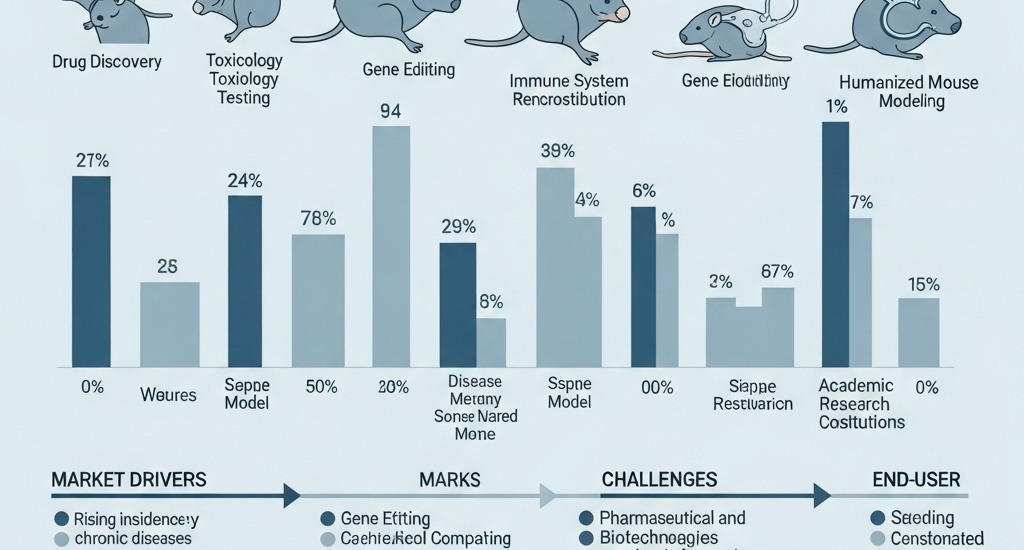
According to Future Market Insights, the global Humanized Mouse Model Market hit USD 113.6 million in 2025. By 2035, it’s projected to surge to USD 119.6 million. That’s no gentle curve. That’s a 5.8% CAGR driven by something very real: desperation—for precision, for speed, for fewer bad bets in the lab.
Let’s be blunt. We’ve spent years chasing targets in mice that don’t reflect human responses. That era is ending. Genetic humanized models are now dominating the space, says FMI. Why? Because pharma and biotech are done with guesswork. They’re paying for relevance.
We’ve spent decades betting on the wrong mice. Traditional lab models—cheap, convenient, and utterly unreliable—have been the backbone of preclinical research. And they’ve failed us. Miserably. Now, a new generation of humanized mice is quietly—but rapidly—changing the rules.
These aren’t your standard test subjects. They carry human genes, tissues, even immune systems. They bleed human biology. In a pharmaceutical landscape riddled with risk and billion-dollar failures, these mice might be our best shot at finally getting drug development right.
Get Sample Report: – https://www.futuremarketinsights.com/reports/humanized-mouse-model-market
🧬 These Mice Aren’t Tools. They’re Strategy.
When a humanized mouse can replicate a human immune reaction, you’re no longer experimenting. You’re simulating. That changes everything. It shortens timelines. Cuts failures. And puts researchers ahead of disease curves that once seemed impossible to trace.
Humanized models are the new preclinical standard for everything from immuno-oncology to metabolic disorders. Their ability to mirror real-world biology is making them less of a novelty—and more of a necessity.

🌍 A Global Arms Race in a Cage
North America still leads, but Asia-Pacific is gaining ground fast, FMI reports. Why? Governments there are investing, and CROs are scaling. It’s a biotech arms race—and humanized mice are the ammunition. This market is now a geopolitical space, not just a scientific one.
The message is simple: if your country isn’t investing in these models, it’s falling behind in the war for biomedical dominance.
⚠️ The Price of Progress Isn’t Cheap. But It’s Worth It.
Humanized mice are expensive. They’re technically demanding. And yes, they’re still animals—not humans. But the alternative? Wasting billions on clinical trials that should’ve never been greenlit. That’s a bigger failure. A more costly one. And no longer excusable.
According to FMI, in vivo testing continues to dominate market share, and for good reason. These mice don’t just offer a better model—they offer a smarter decision framework. One that cuts losses before they spiral.
🧾 Final Word
This market isn’t just growing—it’s correcting a decades-long scientific blind spot. Humanized mice are turning labs into more honest reflections of human biology. That’s not just progress. That’s a reckoning.
As Future Market Insights puts it:
“The Humanized Mouse Model Market is dominated by genetic humanized mouse models, which generated the highest revenue in 2024.”
They’re not exaggerating. These models are no longer optional. They’re essential. And if you’re still using conventional mice to test human treatments in 2025, you’re part of the problem.
Explore In-Depth Analysis-Click Here to Access the Report:- https://www.futuremarketinsights.com/reports/humanized-mouse-model-market
Key Segments :-
By Model Type:
The market is segmented into Genetic and Cell-Based (CD34, PBMC, and BLT).
By Application:
The market is segmented into Oncology, Immunology and Infectious Diseases, Neuroscience, Toxicology, Hematopoiesis, and Other Applications.
By End User:
The market is segmented into Pharmaceutical & Biotechnology Companies, Contract Research Organizations, and Academic & Research Institutions.
By Region:
The Humanized Mouse Model Market is analyzed across North America, Latin America, Western Europe, Eastern Europe, East Asia, South Asia Pacific, and the Middle East & Africa.