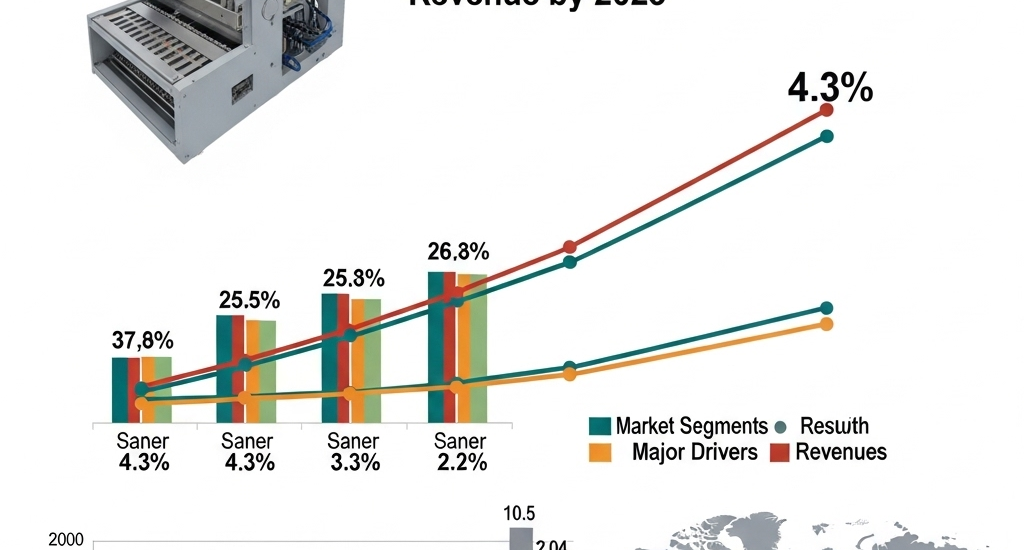
According to Future Market Insights (FMI), the global vibratory feeder machine market is estimated to reach USD 143.5 million by 2025. From 2025 to 2035, the market is expected to grow at a CAGR of 4.3%, surpassing USD 218.6 million in sales by 2035., driven largely by automation in food, pharma, and automotive sectors.
It sounds promising. But let’s be honest: unchecked growth has a way of masking deeper structural issues.
FMI’s data is clear—demand is rising, fast. But this isn’t just a boom. It’s a race. One where manufacturers are adopting vibratory feeders not because they’re ready—but because they’re desperate to keep up.
Request a Sample Report Here: https://www.futuremarketinsights.com/reports/sample/rep-gb-9793
Behind the Hype: A Technology with Unfinished Business
Let’s cut through the fluff. Vibratory feeders are essential—but they’re not infallible. They’re loud, they’re prone to fatigue, and when they break, they halt production cold.
Too often, companies install these machines with little regard for structural stability or vibration control. They skip the engineering. They skip the training. Then they wonder why their shiny new feeder keeps stalling mid-shift.
And it’s not just a mechanical issue. It’s cultural. Many manufacturers still treat maintenance as an afterthought. That’s not just outdated—it’s dangerous.
In Food and Pharma, There’s No Room for Error
FMI rightly points out that vibratory feeders are now critical in high-stakes industries like pharmaceuticals and food. That’s good news—until you realize how many models on the market are still failing basic sanitation design.
If your feeder traps residue or can’t be cleaned without disassembling half the machine, it doesn’t belong in a cleanroom. Period.
In regulated industries, “close enough” doesn’t cut it. These machines need to be engineered for compliance, not just output. And right now, too many aren’t.
Browse Full Report Here: https://www.futuremarketinsights.com/reports/vibratory-feeder-machine-market
Global Expansion, Same Old Problems
Asia Pacific is where most of the growth is coming from. But don’t mistake expansion for maturity. Across China, India, and Southeast Asia, the same issues crop up: improper power calibration, poor installation practices, zero post-sale support.
In other words: different continent, same pain.
Yes, demand is up. But capacity to deploy responsibly? Still catching up.
Wake-Up Call for Manufacturers
The truth? Many factories are installing vibratory feeders they don’t fully understand and can’t properly maintain. The result? More downtime, more waste, and mounting frustration on the floor.
This isn’t sustainable. And if the industry doesn’t tighten its standards, its reputation will suffer—along with its bottom line.
What Needs to Happen—Now
- Stop treating maintenance like a nuisance. Make it central to design.
- Prioritize sanitation. If a feeder isn’t easy to clean, it’s a liability.
- Train your teams. A machine is only as good as the people running it.
- Engineer with context. Feeders don’t operate in a vacuum. They’re part of a system—and that system has limits.
Final Word: Progress Without Precision Is a Problem
The vibratory feeder machine market is no doubt riding a wave. But waves crash. And this one will, too—unless the industry grows smarter, not just faster.
The machines may be vibrating, but the signal is clear: it’s time to stop chasing volume and start demanding integrity.
Latest Manufacturing Equipment Reports: https://www.futuremarketinsights.com/industry-analysis/manufacturing-equipment
Key Companies Profiled
- Eriez;
- Carrier Vibrating Equipment, Inc.;
- General Kinematics;
- Fortville Feeders, Inc.;
- Vibrating Flight Systems Inc.;
- Home City Automation, Inc.;
Vibrating Equipment, Inc.