The dry vacuum cleaner market, once viewed as a standard segment of the broader home appliances industry, is undergoing a quiet transformation. What was once considered a household necessity is now finding a significant foothold in commercial and institutional spaces. This shift, driven by heightened hygiene awareness and post-pandemic indoor air quality (IAQ) standards, is giving rise to a new wave of demand for efficient, HEPA-enabled dry vacuum cleaners—especially in settings where public footfall is high and air quality compliance is no longer optional.
The Changing Perception of Vacuum Cleaning
Traditionally, dry vacuum cleaners have been marketed for residential use—efficient, lightweight, and designed for carpets, rugs, and hardwood floors. However, in the wake of global health events and renewed focus on sanitization, businesses have begun to view vacuum cleaners not just as floor-cleaning tools, but as air quality enablers. In particular, commercial establishments like hospitals, schools, airports, hotels, and corporate offices have started integrating dry vacuums with HEPA filters into their daily cleaning protocols.
Request for Report Sample: https://www.futuremarketinsights.com/reports/sample/rep-gb-9792
The post-pandemic period ushered in stricter air quality guidelines across North America, Europe, and Asia. For instance, the United States Environmental Protection Agency (EPA) and OSHA guidelines now recommend regular removal of fine particulate matter (PM2.5, PM10) from indoor surfaces as part of overall IAQ management. This has led to greater demand for high-performance dry vacuum cleaners capable of capturing allergens, microbes, and fine dust particles—not just cleaning visible dirt.
Commercial Sector: The New Growth Driver
While household demand continues to rise steadily, particularly with smart and cordless vacuum cleaners, it’s the commercial sector that’s driving market differentiation. Facilities management companies are now investing in vacuum cleaner fleets with standardized specifications—quiet operation, long runtime, dust bag sensors, and HEPA-level filtration.
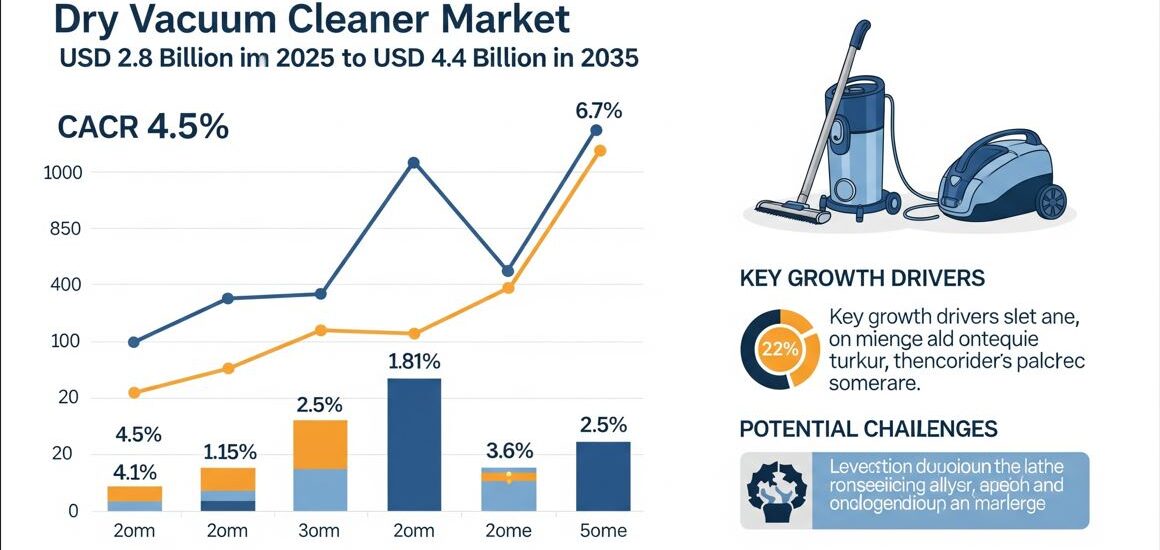
According to Future Market Insights, the Dry Vacuum Cleaner Market is projected to grow from USD 2.8 billion in 2025 to USD 4.4 billion by 2035, at a CAGR of 4.5%.
Take for example the hospitality sector, where room cleanliness is directly tied to customer satisfaction and brand reputation. Hotels are now moving away from outsourced housekeeping models and investing in their own cleaning technologies to retain greater control over hygiene. In this case, dry vacuum cleaners with multi-surface compatibility and quiet motors are becoming default assets.
Similarly, in schools and public libraries, local governments have issued mandates requiring the use of vacuum cleaners that meet specific HEPA filtration criteria. This shift isn’t driven by aesthetic cleanliness alone but also by the need to maintain safe environments for children and vulnerable groups—especially in regions like the European Union and parts of Canada, where environmental health regulations are tightening.
Browse the Complete Report: https://www.futuremarketinsights.com/reports/dry-vacuum-cleaner-market
Technology Driving Differentiation
Dry vacuum cleaner manufacturers have responded to this changing demand pattern with several innovations. New models in 2024 and 2025 have begun incorporating smart sensors, battery optimization, and quiet technology for use in environments that require minimal disruption.
Interestingly, the cordless segment has expanded rapidly in commercial spaces due to improved battery technology. Battery-powered dry vacuums used to be confined to lightweight residential models, but now, lithium-ion battery packs with up to 60 minutes of runtime are enabling cordless operation even in mid-sized office buildings.
Another notable development is IoT-enabled vacuum cleaners. Some premium commercial models come with fleet management apps that allow building supervisors to track usage time, schedule filter changes, and remotely manage maintenance routines. While this may sound niche, for facilities managing hundreds of cleaning units across multiple buildings, this capability can lead to significant time and cost savings.
Regional Adoption Patterns
Regionally, adoption trends vary widely. North America and Western Europe are leading in terms of commercial uptake of advanced dry vacuum cleaners, particularly those meeting IAQ-related compliance standards. In contrast, Asia-Pacific—led by Japan, South Korea, and India—is showing faster unit sales growth driven by urbanization, rising disposable incomes, and a growing service sector.
For example, India’s growing coworking space boom has led to increased demand for dry vacuum cleaners among facility management startups. These businesses, often operating on tight SLAs (service-level agreements), are investing in reliable, industrial-grade vacuums that require less maintenance and downtime.
Meanwhile, in Japan, cultural emphasis on cleanliness combined with technological affinity has made it a testbed for robotic dry vacuum cleaners in commercial buildings. Though these robotic cleaners are still largely used in residential settings globally, Japan’s experiments with robotic custodial equipment are reshaping future use cases.
Operational Equipment Industry Overview: https://www.futuremarketinsights.com/industry-analysis/operational-equipment
Challenges and Forward Outlook
Despite these opportunities, the dry vacuum cleaner market still faces a few challenges. Price sensitivity in emerging markets often leads consumers toward cheaper, unbranded products that may not meet quality standards. In the commercial sector, the upfront cost of high-performance vacuums with HEPA filters and smart tech features can be a hurdle for smaller businesses.
However, the cost-benefit ratio is becoming increasingly favorable. Businesses are starting to realize that investing in reliable, low-maintenance cleaning devices reduces operational disruptions and enhances customer trust. Additionally, with a growing number of countries enforcing clean building certifications and sustainability ratings, high-quality dry vacuum cleaners are no longer optional—they’re a part of the operational checklist.