Let’s be blunt: industrial food is failing us. Americans are bloated, inflamed, and confused by labels designed more for marketing than health. In the chaos, one ancient method is making a defiant comeback—fermentation.
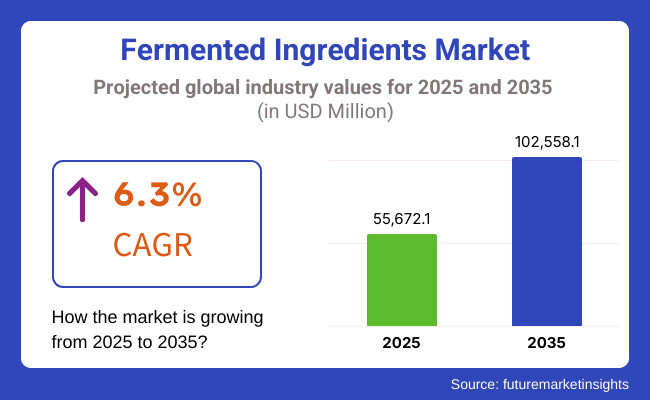
And this isn’t some niche revival. According to Future Market Insights (FMI), the global fermented ingredients market is set to surge from $38.11 billion in 2024 to $59.9 billion by 2029. That’s a fierce 9.7% annual growth rate, driven by a planet-wide hunger for something better—for food that actually works with our bodies, not against them.
FMI doesn’t mince words: the spike in obesity, gut disorders, and immune dysfunction is fueling this shift. Fermented ingredients, rich in lactic acid bacteria and bioactive compounds, are no longer “alternative.” They’re becoming essential.
Unveil Market Trends: Get Your Sample Report Now: https://www.futuremarketinsights.com/reports/sample/rep-gb-11026
This Is Bigger Than Kombucha
Yes, kombucha and kimchi are on the shelves. But this is much deeper. FMI outlines a global transformation: manufacturers are turning to fermentation not just for flavor—but for survival. It’s a clean-label solution in a world sick of additives. It’s plant-based, allergen-friendly, and scalable. In other words, it hits every hot-button consumer demand—and still manages to deliver real functionality.
Europe and Asia, long comfortable with fermented staples, are setting the pace. But North America is catching fire. The U.S. and Canada dominate global value. Canada, in particular, is sprinting ahead with one of the highest projected growth rates—driven by its multicultural palate and growing distrust of industrial food.
Rising Interest in Market Trends: Our Detailed Report Provides Essential Insights:https://www.futuremarketinsights.com/reports/fermented-ingredients-market
Precision Fermentation Is Coming Fast—Maybe Too Fast
FMI calls out precision fermentation as the next frontier. Think lab-grown dairy proteins, designer enzymes, and fermentation-enabled meat alternatives. On paper, it’s brilliant—zero animals, minimal emissions, max control.
But here’s the problem: it’s still biotechnology. And most consumers don’t even know what that means. We’re entering an era where “fermented” could describe both your grandmother’s sauerkraut and a vat-engineered enzyme coded in a cleanroom. That’s not inherently bad—but let’s not pretend it’s the same thing.
The market may be ready. The public isn’t. Not yet.
The American Gut Is Ground Zero
This isn’t just a business story. It’s a health emergency. Digestive issues are exploding. Antibiotic damage, ultra-processed diets, and fiber-starved routines have left millions wrecked from the inside out. Fermented ingredients—real ones, not gimmicks—are one of the few tools we have left that are both effective and ancient.
And people know it. That’s why sales are climbing. That’s why kombucha is in gas stations. That’s why sourdough recipes went viral in a pandemic and stayed popular.
But the food industry must be held accountable. If fermentation becomes just another buzzword slapped on lab projects and sugar bombs, we will have lost the plot again.
Fermentation Is the Correction We Need
Let’s be clear: fermentation is not a fad. It’s a correction. A course reversal in a world obsessed with shelf life over health span.
FMI’s data makes it official. But the cultural shift? That’s already underway. People want food that feeds them, literally and figuratively. They want microbes, not marketing.
This is more than a market trend. It’s a reckoning. And it’s long overdue.
Company Profile
-
- Ajinomoto Corporation Inc
- Allied Bakeries
- Angel yeast Co., Ltd.
- Associated British Food (ABF)
- Bakels
- BASF SE
- Cargill Incorporated
- CHR. Hansen A/S
- CSK Food Enrichment
- Dawn Food Products
 Explore Functional Food Ingredients Industry Analysis: https://www.futuremarketinsights.com/industry-analysis/functional-food-ingredients
Key Segmentation
By Product Type:
- Amino Acids
- Organic Acids
- Biogas
- Polymer
- Vitamins
- Antibiotics
- Industrial Enzymes
By Application:
- Food & Beverages
- Pharmaceuticals
- Paper
- Feed
- Personal Care
- Biofuel
- Others
By Process:
- Batch Fermentation
- Continuous Fermentation
- Aerobic Fermentation
- Anaerobic Fermentation
By Form:
- Liquid
- Dry
By Region:
- North America
- Latin America
- Western Europe
- Eastern Europe
- East Asia
- South Asia Pacific
- Middle East and Africa