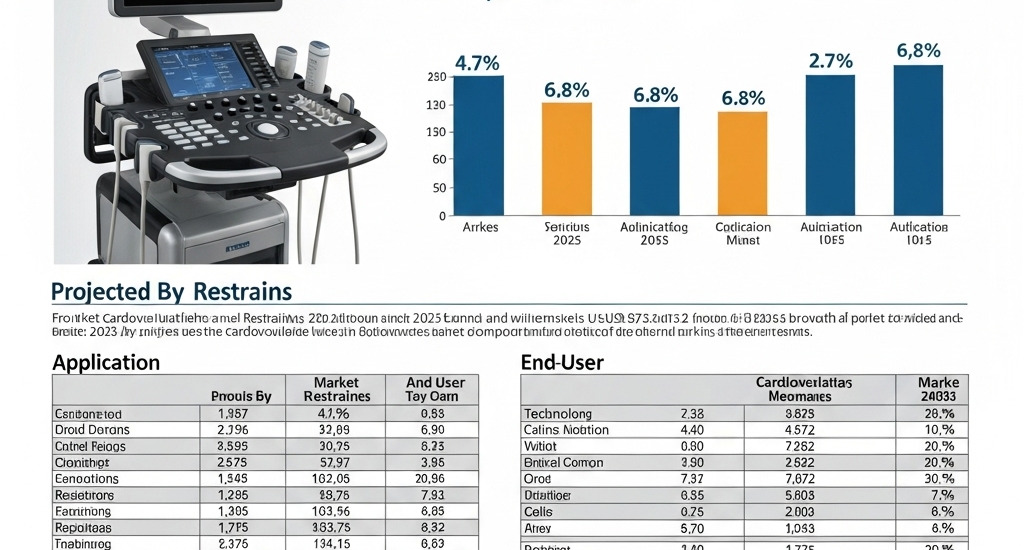
The cardiovascular ultrasound industry is exploding. It’s not a slow burn—it’s a full‑tilt sprint. According to Future Market Insights (FMI), the market stood at USD 1,421.6 million in 2025 and is on track to USD 2,873.2 million by 2035. This isn’t just another med-tech growth story. It’s a red siren flashing over modern healthcare.
Get Sample Report: – https://www.futuremarketinsights.com/reports/sample/rep-gb-16514
🇺🇸 America’s Starring Role, and Its Biggest Bottlenecks
The U.S. leads this charge—commanding over 30% of the global share, per FMI. That makes sense. The country has the infrastructure, the patient load, and the money. But it also has something else: chaos.
Despite the booming market, many hospitals and clinics remain fundamentally unprepared. Equipment is bought faster than staff are trained. Imaging systems become showpieces—underutilized, under-integrated, and often misunderstood. That’s not innovation. That’s negligence.
FMI notes that hospitals remain the largest segment, but outpatient and ambulatory centers are closing in. That shift should be a win. But only if we fix the basics—starting with the people behind the machines.
💡 Tech Isn’t the Problem. People Are.
Let’s be blunt. The machines work. Ultrasound tech is smarter, faster, more accurate than ever. We have 2D, Doppler, even 4D imaging becoming standard. But tech doesn’t save lives—trained professionals do. And we don’t have enough of them.
FMI’s data points to a glaring reality: the workforce gap is widening. We’re rolling out next-gen tools without building next-gen teams. In too many settings, sophisticated machines sit idle because there’s no one skilled enough to use them properly.

Systemic Friction and the Myth of Readiness
Don’t be fooled by the numbers. Growth doesn’t mean readiness. FMI highlights a host of issues that get buried under market optimism:
- Reimbursement remains a mess. U.S. payment systems lag behind reality. Some procedures get reimbursed. Others don’t. It’s inconsistent and it’s costing lives.
- Access is still a privilege. Rural hospitals? Underfunded. Community clinics? Outdated machines, if any. The tech revolution is still mostly urban and elite.
- Workflow integration is broken. New ultrasound units aren’t always compatible with old hospital systems. That’s not progress—that’s digital gridlock.
Explore In-Depth Analysis-Click Here to Access the Report:- https://www.futuremarketinsights.com/reports/cardiovascular-ultrasound-market
Final Take: Double the Market, or Double the Mess?
It’s tempting to celebrate a market that’s poised to double in value. But growth doesn’t equal progress—not in healthcare. What FMI’s forecast really shows is a widening gap between potential and performance.
We’re sitting on an imaging revolution. That should be thrilling. But instead, it’s frustrating. Because we know how to save lives—we just keep failing to build systems that let us.
If we don’t fix training, access, and reimbursement, the cardiovascular ultrasound boom could become a tragic case of wasted potential. The tools are here. The urgency is here. But so far, the system? Still miles behind.
Key Segments:-
By Type:
- Fetal Echocardiography
- Transthoracic Echocardiography
- Transesophageal Echocardiography
- Others
By Technology:
- 2D
- 3D/4D
- Doppler
By Display Type:
- B/W
- Color
By End-use:
- Hospitals
- Diagnostic Centers
- Ambulatory Care Centers
- Other End-uses