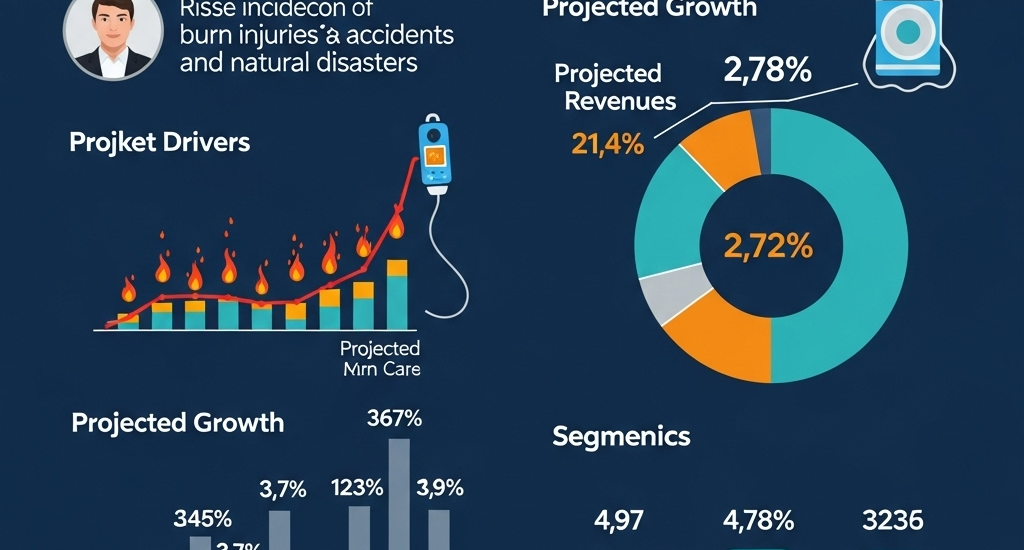
According to Future Market Insights (FMI), the global burn care industry is set to more than double—from USD 2,023.5 million in 2025 to USD 4,660.1 million by 2035. That’s a compound annual growth rate of 7.9%.
From overcrowded clinics in Lagos to under-equipped trauma centers in Dhaka, burn victims suffer in silence. Children scalded by boiling water. Women disfigured by open cooking flames. Laborers mangled by factory accidents. The agony is real. The care? In most parts of the world—nonexistent.
Get Sample Report: – https://www.futuremarketinsights.com/reports/sample/rep-gb-12621
FMI attributes this spike to advances in biologics, hydrogel dressings, synthetic grafts, and enzymatic debriders. These technologies are extraordinary. Life-changing. In some places, even life-saving. But let’s be honest: only a small fraction of the world will ever see them.
North America and Western Europe dominate this market. Not because they carry the largest burn burden—but because they have the money. The hospitals. The insurance systems. In contrast, the very regions where burns are most prevalent—South Asia, Sub-Saharan Africa, parts of Latin America—remain afterthoughts in supply chains and R&D strategies.
FMI’s forecast is clear: investment is flowing to where return is guaranteed. Not where need is greatest.
Here’s what no executive presentation will say: the burn care market is thriving precisely because the system is broken. The rich can afford complex grafts and scar-reducing therapies. The poor? They’re lucky if they get antibiotics.
And that’s the scandal hiding beneath the spreadsheet.
Burn care shouldn’t be a privilege. It should be a human right. If a child’s skin can be regenerated in Boston, then a child’s life shouldn’t be lost in Bangladesh for lack of gauze and clean water.
But this won’t change unless we force the conversation. We must hold the companies riding this boom to a higher moral bar. Growth must come with responsibility. With pricing models for emerging markets. With licensing deals that prioritize lives over profits. With tech transfers and training—not just press releases and patents.
The burn care sector stands at a crossroads. One road leads to deeper inequality masked by innovation. The other? A healthcare revolution—if industry leaders choose to make access part of their agenda.
Explore In-Depth Analysis-Click Here to Access the Report:- https://www.futuremarketinsights.com/reports/sample/rep-gb-12621
Key Segments
By Product Type:
- Burn Wound Dressings
- Topical Burn Medications
By End Use:
- Household
- Hospitals
- Clinics
- Others
By Severity:
- First Degree Burns
- Second Degree Burns
- Third Degree Burns
By Sales Channel:
- Online Channel
- Offline Channel
By Region:
- North America
- Latin America
- Europe
- East Asia
- South Asia
- Oceania
- MEA