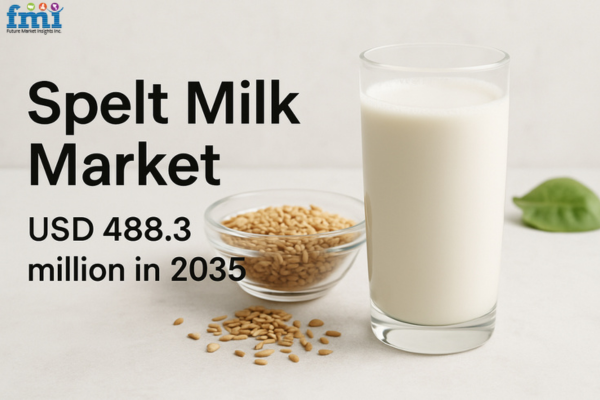
A quiet but meaningful disruption is taking place in grocery aisles, and the dairy industry should be paying closer attention. Spelt milk—a lesser-known, grain-based alternative—is emerging as a serious contender in the plant-based milk race. And no, this isn’t just another trendy non-dairy beverage doomed to the back shelf.
As per Future Market Insights, the global spelt milk market is expected to grow from USD 253 million in 2025 to USD 488 million by 2035, clocking a healthy 6.8% CAGR. These are not vanity numbers. They represent a deeper shift in consumer behavior—one that’s being driven by health, sustainability, and an urgent rejection of the overly industrialized dairy complex.
Your Guide to Market Intelligence – Download a Sample Copy: https://www.futuremarketinsights.com/reports/sample/rep-gb-15019
Spelt Milk Isn’t for Everyone—And That’s the Point
Let’s be clear: spelt milk will never outsell oat milk, and it probably doesn’t need to. Unlike mass-market alternatives overloaded with sugar and additives, spelt milk caters to an evolving consumer—the one who reads labels, checks ingredients, and demands transparency. It’s clean, often organic, and more digestible than many dairy-free options.
Nutritionally, spelt milk stands its ground. It brings natural fiber, essential minerals, and B-vitamins to the table. It’s free from lactose, cholesterol, and unnecessary processing. Most importantly, it doesn’t pretend to be something it’s not.
So Why Isn’t It Everywhere?
One word: awareness. Most Americans haven’t even heard of spelt. The average consumer is still toggling between oat and almond, unaware that other, arguably better, options exist.
And yes, price is a problem. Spelt is harder to grow, and the supply chain is smaller. That makes spelt milk more expensive—but maybe that’s okay. Not every food product needs to be mass-produced into mediocrity. This is a beverage for people who care about what they drink, not just how cheap it is.
There’s also the matter of taste. Spelt milk has a distinct, malty nuttiness—earthy and smooth. It won’t mimic cow’s milk perfectly. But then again, why should it? Not every alternative needs to be an imitation. Spelt milk’s uniqueness is its strength, not a flaw.
Europe Gets It. The U.S. Is Still Catching Up.
Europe, particularly Germany and the U.K., has long embraced spelt in both baking and dairy-free innovations. According to Future Market Insights, nearly 39% of global spelt milk revenue in 2024 came from Europe alone.
The U.S., by contrast, remains in catch-up mode. North America is expected to be the fastest-growing market, but it’s still hampered by a lack of product visibility, limited distribution, and weak brand storytelling. If American companies don’t move quickly, they’ll miss the chance to shape this category—and the narrative around it.
The Bottom Line: Not a Trend. A Statement.
Spelt milk is not here to be trendy. It’s here to challenge assumptions—about dairy, about health, and about what we put in our bodies.
It’s not for everyone. But maybe that’s exactly why it matters. It stands apart from the generic, over-marketed plant milks that dominate the shelves. Spelt milk says: we can do better. We can farm better, eat better, and make smarter choices without sacrificing flavor or conscience.
If the food industry truly cares about the future of health and sustainability, it can’t afford to ignore spelt milk any longer. It’s time this ancient grain got the spotlight it deserves.
Stay Ahead with the Complete Market Analysis – Download Full Report: https://www.futuremarketinsights.com/reports/spelt-milk-market
Leading companies in the spelt milk market include THE BRIDGE S.R.L, Allos, Natumi Organic, Provamel, Ecomil, Isola Bio (Abafoods Srl), Poggio Organic, and BioSophia.
Key Segmentation
By Ingredients:
The market includes products enriched with Fiber, Gluten, Proteins, Vitamins, and Minerals, catering to various nutritional needs.
By Distribution Channel:
Products are available through Online and Offline sales channels, ensuring widespread consumer accessibility.
By Form:
The market is segmented into Dry and Liquid forms, offering versatility in product consumption.
By Flavor:
Consumers can choose from flavors such as Natural, Almond, and Others, providing diverse taste options.
By Region:
Industry analysis has been carried out in key countries of North America, Latin America, Western Europe, Eastern Europe, Balkans & Baltic, Russia & Belarus, Central Asia, East Asia, South Asia & Pacific, and the Middle East & Africa.