It’s bitter. It’s dusty. It smells like something scraped off the floor of a brewery. And yet, it’s being pitched as a superfood. Brewer’s yeast powder is having a moment—just don’t assume everything you’re hearing about it is real.
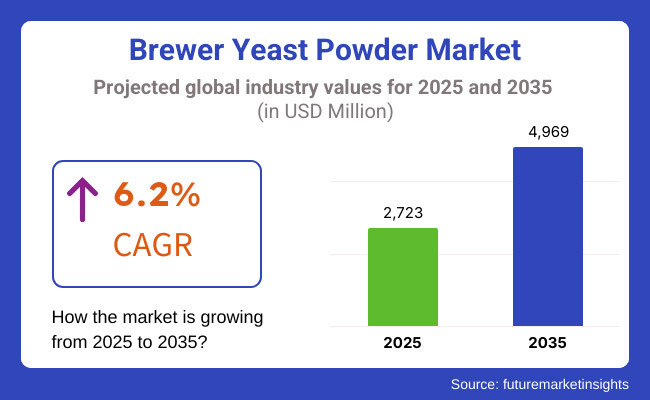
A recent report from Future Market Insights says the global brewer’s yeast powder market is set to expand significantly over the next decade. Global consumption of brewer yeast powder stood at around USD 2,723 million in 2025 and is slated to increase at a CAGR of 6.2% to reach a value of USD 4,969 million by 2035.
But let’s cut through the enthusiasm. The science is limited. The regulation is weak. And the marketing is, in many cases, completely out of control.
Explore Key Trends in the Market: Request Your Sample Report: https://www.futuremarketinsights.com/reports/sample/rep-gb-11603
The Promise vs. Reality Gap
Brewer’s yeast powder is nutrient-dense. That’s a fact. It’s packed with B vitamins, chromium, selenium, and protein. It has real clinical potential—as some small-scale studies suggest it may help manage blood sugar levels or support gut health.
But what it isn’t is magic. And it certainly isn’t a one-size-fits-all wellness cure.
Despite the booming market, there’s no FDA requirement to prove that any of the health claims printed on tubs and pouches of brewer’s yeast powder are true. That’s because most of it is sold under the GRAS (Generally Recognized As Safe) designation—a regulatory gray zone where food and supplement blur into a legal blind spot.
It’s a loophole. And companies are sprinting through it.
Growing Need for Market Insights: Access Our Full Report for Thorough Analysis and Trends: https://www.futuremarketinsights.com/reports/brewer-yeast-powder-market
We’ve Been Here Before
This isn’t a new story. First it was spirulina. Then maca. Then ashwagandha. Now it’s brewer’s yeast. Every few years, the wellness world finds a new “ancient” or “natural” product to dress up in modern packaging and sell as the missing link to your personal health revolution.
The problem? These fads aren’t backed by oversight. They’re backed by copywriters.
A Market That’s Moving Too Fast
FMI’s data shows rising adoption across health-conscious consumers, athletes, vegans, and even pet owners. Brewer’s yeast powder is being added to smoothies, protein shakes, baked goods—even dog food.
But here’s the problem: the industry is scaling faster than the science. There are no standardized dosages. No verified guidelines. No required disclosures on interactions with medications or contraindications for people with compromised immune systems.
Put plainly, we’re treating this stuff like medicine without testing it like medicine.
Who’s Protecting the Consumer?
At the moment? Practically no one.
Under U.S. law, unless a product makes explicit disease-treatment claims, the FDA won’t step in. That means most yeast powders can boldly state benefits like “supports energy” or “aids immunity” without ever proving a thing.
It’s a familiar story: big claims, little accountability.
Meanwhile, consumers trust the label, assume it’s backed by research, and start spooning it into their food every morning. It’s not just misleading—it’s reckless.
A Call for Action, Not Just Innovation
There’s nothing wrong with brewer’s yeast powder itself. In fact, it has legitimate nutritional value. What’s wrong is the Wild West environment surrounding how it’s marketed and sold.
If the FMI report is accurate—and the market really is poised for explosive growth—then we need to act fast. That means:
- Mandatory clinical trials before allowing therapeutic claims.
- Stricter labeling laws for supplements sold through food channels.
- Federal oversight that reflects how these products are actually being used.
Right now, too many brands are gaming the system. They’re selling the illusion of health, not health itself.
Bottom Line
The brewer’s yeast powder boom is real. The growth is measurable. The potential is there. But so is the misinformation.
And if we don’t stop pretending that “natural” means safe and “nutritional” means tested, we’re going to end up exactly where we always do—playing catch-up after the damage is done.
It’s time for regulators to get serious. Because this market doesn’t need more hype. It needs honesty.
 Key Company Profile
-
- Inland Island Yeast Laboratories
- Lesaffre
- Associated British Foods plc
- Lallemand Inc.
- Angel Yeast Co. Ltd
- AB Mauri Ltd
- Laffort SA
- Alltech Inc.
- Oriental Yeast Co. Ltd
- Omega Yeast Labs
Functional Food Ingredients Industry Analysis: https://www.futuremarketinsights.com/industry-analysis/functional-food-ingredients