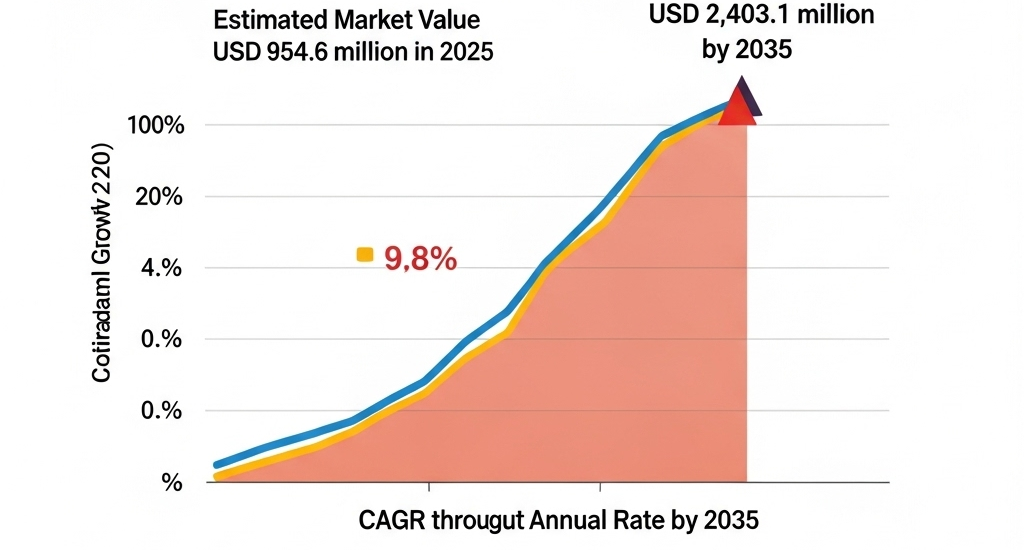
The global anti-biofilm wound dressing market is estimated to be valued at USD 954.6 million in 2025 and is projected to reach USD 2,403.1 million by 2035, registering a compound annual growth rate (CAGR) of 9.8% over the forecast period. The anti-biofilm wound dressing market is experiencing notable growth, driven by increasing awareness of chronic wound management and the advancement of medical dressing technologies. Anti-biofilm dressings are designed to disrupt or prevent the formation of biofilms—structured communities of bacteria that form on wound surfaces and impede healing. Traditional wound dressings often fall short when dealing with biofilm-affected wounds, making this specialized segment increasingly relevant in modern healthcare.
- The market is driven by the rising prevalence of diabetic foot ulcers, pressure ulcers, and venous leg ulcers.
- Healthcare providers are adopting advanced dressings to reduce hospital stays and improve patient outcomes.
- Increasing demand for wound care solutions in aging populations is contributing significantly to market expansion.
- Technological innovations in dressing materials and delivery mechanisms are enhancing the performance of anti-biofilm solutions.
Get Sample Report: – https://www.futuremarketinsights.com/reports/sample/rep-gb-16474
Market Trends
Current trends in the anti-biofilm wound dressing market are shaped by both innovation and patient-centric care approaches. Healthcare systems are under pressure to provide efficient and cost-effective treatments that promote faster healing and reduce the chances of infection recurrence.
- Surge in research & development of combination dressings that include antimicrobial agents and biofilm-disrupting technologies.
- Growing popularity of silver-infused and iodine-based dressings due to their effectiveness against biofilms.
- Integration of smart wound care systems with sensors to monitor healing in real-time.
- Rising adoption in outpatient and home healthcare settings, reducing reliance on inpatient services.
- Sustainability-focused product development using biodegradable and eco-friendly materials.
Challenges and Opportunities
Despite promising growth, the anti-biofilm wound dressing market faces several challenges that could impact its trajectory. However, these challenges also create new opportunities for innovation and expansion.
Challenges:
- High cost of advanced wound dressings compared to traditional options.
- Limited awareness and training among healthcare professionals in some regions.
- Regulatory hurdles related to product approval and classification.
Opportunities:
- Untapped markets in low- and middle-income countries with rising healthcare investments.
- Collaborations between biotech firms and academic institutions to develop next-gen biofilm-resistant materials.
- Potential for personalized wound care solutions based on genetic and microbial profiling.
Key Points:
- Biofilms hinder wound healing and require specialized solutions for effective treatment.
- Anti-biofilm dressings offer faster recovery and reduce the risk of chronic wound complications.
- Increasing prevalence of chronic wounds globally is a major growth driver.
- Rising healthcare spending is supporting the development and adoption of advanced wound care products.
- Supportive government initiatives and funding in healthcare research are aiding market development.
Key Regional Insights
The anti-biofilm wound dressing market is experiencing varied growth across different regions, driven by healthcare infrastructure, spending patterns, and disease prevalence.
- North America leads the market due to advanced healthcare systems, strong R&D, and high awareness levels.
- Europe follows closely, supported by favorable reimbursement policies and a growing elderly population.
- Asia-Pacific is witnessing rapid growth, especially in countries like China, India, and Japan, due to expanding healthcare access and increasing investments.
- Latin America and Middle East & Africa are emerging markets with potential for high growth, although they currently face infrastructure and affordability challenges.
Top Companies
Several major players are shaping the competitive landscape of the anti-biofilm wound dressing market, focusing on innovation, mergers, and expanding global reach.
- Smith & Nephew plc – Known for pioneering advanced wound care solutions.
- Mölnlycke Health Care AB – Offers a diverse range of dressings targeting biofilm-infected wounds.
- 3M Company – Integrates science and technology to deliver multifunctional wound dressing products.
- ConvaTec Group PLC – Focused on patient-centric innovation in wound management.
- Coloplast A/S – Provides cutting-edge wound healing technologies and has a strong global distribution network.
- Startups and mid-sized biotech firms are also entering the market with niche, specialized offerings.
Explore In-Depth Analysis-Click Here to Access the Report:- https://www.futuremarketinsights.com/reports/anti-biofilm-wound-dressing-market
Segmentation Outlook
The anti-biofilm wound dressing market can be segmented across several key criteria to better understand its structure and dynamics.
- By Product Type:
- Silver-based dressings
- Iodine-based dressings
- Honey-based dressings
- Others (enzymatic, hydrogel, etc.)
- By Application:
- Diabetic foot ulcers
- Pressure ulcers
- Surgical wounds
- Burns
- Other chronic wounds
- By End-user:
- Hospitals
- Ambulatory surgical centers
- Home healthcare
- Clinics
- By Region:
- North America
- Europe
- Asia-Pacific
- Latin America
- Middle East & Africa