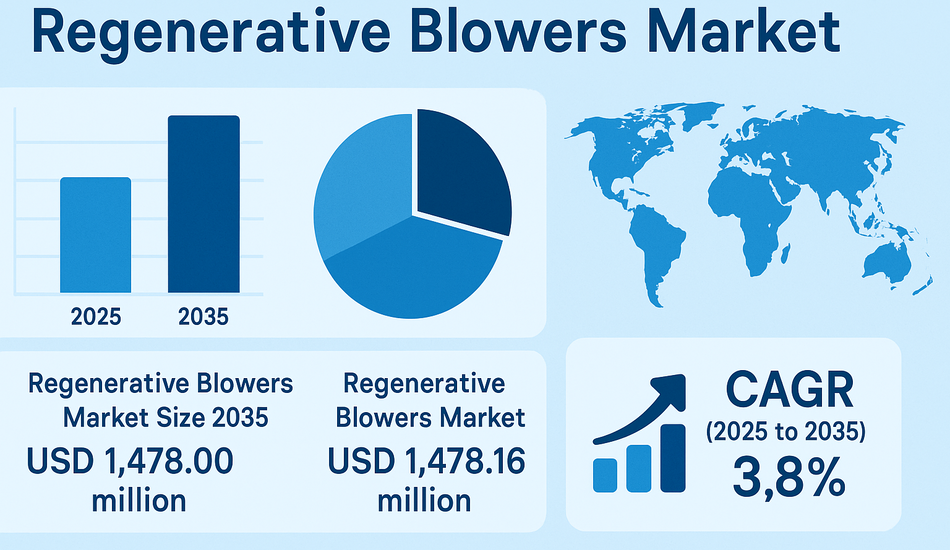
According to the latest industry research, the global Regenerative Blowers Market is projected to grow from USD 1,018.00 million in 2025 to USD 1,478.16 million by 2035, registering a CAGR of 3.8% over the forecast period. Also known as side-channel blowers, regenerative blowers are gaining significant traction in diverse sectors including manufacturing, pharmaceuticals, food and beverage processing, and wastewater treatment.
The market is witnessing accelerated momentum due to rising investments in industrial automation, enhanced focus on energy efficiency, and growing applications in aeration, pneumatic conveying, and vacuum lifting. As industries continue to modernize their operations, regenerative blowers offer a compelling solution owing to their oil-free, compact, and maintenance-friendly design.
Moreover, stringent environmental regulations and a shift towards sustainable air handling systems are also influencing the adoption of regenerative blowers globally. Their utility in clean and dust-free air movement across manufacturing setups and eco-sensitive areas underpins their value proposition.
Gain Valuable Insights from Industry Experts to Shape Your Growth Strategies. Access our Sample Report Now: https://www.futuremarketinsights.com/reports/sample/rep-gb-16713
The advancement of high-pressure blower technology, along with a growing trend of integrating variable-speed drives, has elevated their performance metrics, especially in energy-conscious environments. This has further diversified their usage across segments such as chemical, electronics, and construction industries.
Report Coverage & Deliverables
The research report provides in-depth insights into key market dynamics, future trends, and competitive benchmarking. It covers:
- Market size and forecast (2025–2035)
- Segment-wise analysis (by product type, application, end-use industry)
- Technology and innovation trends
- Regulatory and policy framework
- Competitive landscape with company profiling
- Regional and global opportunity mapping
Key Factors Shaping Market Dynamics
The market is shaped by a complex interplay of regulatory compliance, energy-saving imperatives, and increasing demand for compact, oil-free air solutions in space-constrained industrial environments.
High Initial Costs and Energy Consumption
Despite long-term savings, the initial capital investment in regenerative blowers remains a barrier, especially for small-to-medium enterprises. These costs include not only the equipment but also ancillary automation, control units, and noise reduction accessories.
Additionally, while regenerative blowers offer oil-free operation, energy consumption in certain high-pressure applications remains a concern. Without optimized impellers and motors, energy costs can outweigh the operational benefits in specific use cases.
Noise and Performance Limitations in High-Pressure Applications
Noise generation is another challenge associated with regenerative blowers, especially at higher operational speeds or when handling dense materials. Sound dampening technologies and acoustic enclosures are helping to address this concern.
Furthermore, performance tends to plateau at extreme pressure ranges, making them less suitable for applications demanding ultra-high compression. Innovations in multi-stage configurations are currently being explored to resolve this issue.
Rising Demand for Industrial Automation and Wastewater Treatment
The increasing shift toward smart factories and automated production lines is fueling the demand for regenerative blowers, given their reliability, minimal maintenance needs, and adaptability to automated controls.
Wastewater treatment facilities worldwide are adopting regenerative blowers for efficient aeration, a crucial process in biological waste breakdown. Their low pulsation air delivery and compact design enhance system efficiency and operational uptime.
“Regenerative blowers are redefining industrial airflow with their efficiency, making them a strategic fit for automated, eco-driven operations.”
Key Takeaways
The market is set to witness consistent demand, particularly from sectors prioritizing oil-free, energy-efficient air movement. The growing use of regenerative blowers in clean manufacturing, sustainable waste management, and factory automation is expected to drive long-term market performance.
Browse Full Report Here: https://www.futuremarketinsights.com/reports/regenerative-blowers-market
Growth in Renewable Energy and Sustainable Manufacturing
The push for green energy and decarbonized manufacturing has positively impacted the regenerative blowers market. Their oil-free operation aligns with zero-contamination objectives in solar panel and battery manufacturing sectors.
As industries transition to sustainable energy models, regenerative blowers are being adopted in support systems such as cooling, air circulation, and gas handling, reinforcing their versatility and green potential.
Compliance with Industrial Emissions and Energy Efficiency Standards
Regenerative blowers help facilities comply with ISO 50001 and energy-related emissions norms by offering a consistent, oil-free alternative to conventional compressors.
With governments and environmental agencies tightening efficiency mandates, the integration of energy-smart blowers in operations enables industries to meet targets without compromising productivity.
Growth in Energy-Efficient Impellers and Variable-Speed Blowers
Ongoing R&D in impeller aerodynamics and noise suppression is fueling the development of next-generation blowers that offer higher airflow with reduced input power.
The rise of variable-frequency drive (VFD) compatible blowers enables operators to dynamically adjust output, reducing idle energy consumption and enhancing system responsiveness under varying load conditions.
Regenerative Blowers Market Key Players
- Busch Vacuum Solutions – Offers a wide range of high-performance side channel blowers tailored for food processing and medical sectors.
- Gardner Denver (Ingersoll Rand) – Known for their oil-free regenerative blowers with low noise and modular control options.
- Hitachi Industrial Equipment Systems Co., Ltd. – Focuses on energy-efficient and compact blower systems for the Asian and global markets.
- Becker Pumps Corporation – Offers both single and double-stage regenerative blowers, ideal for industrial and environmental applications.
- Aerzen Group – Renowned for robust blower systems used in wastewater treatment and bulk material handling.
Demand for Efficient Aeration and Industrial Air Circulation
Growing demand for precision air circulation in electronics, packaging, and textile industries has placed regenerative blowers at the forefront of ventilation systems.
Additionally, aeration for aquaculture and sewage treatment is one of the fastest-growing application areas. The blowers’ ability to operate continuously with minimal servicing is a key differentiator in such mission-critical environments.
Regional Analysis
- North America: Dominated by high adoption in automated industries and growing demand for wastewater treatment infrastructure.
- Latin America: Emerging market, with rising investment in food processing and clean water technologies.
- Western Europe: Focused on environmental compliance, leading to strong demand for energy-efficient systems.
- Eastern Europe: Slow yet steady adoption as industries modernize, especially in automotive and construction sectors.
- Asia Pacific: Fastest-growing region driven by industrial expansion in China, India, and Southeast Asia.
- Middle East & Africa: Adoption tied to urban water management projects and smart city initiatives.
Latest Industrial Thermal & HVAC Solutions Reports: https://www.futuremarketinsights.com/industry-analysis/industrial-thermal-and-hvac-solutions
Key Segmentation
By Stage:
- Single-stage
- Three-stage
- Two-stage
By End User:
- Water & Wastewater Treatment
- Oil & Gas, Food & Beverages
- Chemical
- Medical & Healthcare
- Aquaculture
- Industrial
- Others
By Region:
- North America
- Latin America
- East Asia
- South Asia & Pacific
- Eastern Europe
- Western Europe
- Middle East & Africa
Explore FMI’s Extensive Coverage on Industrial Automation Domain:
The rotary indexer market is to grow at a CAGR of 3.2% and reach USD 1,204.83 million by 2035
The APAC solar micro inverters industry is to grow at a CAGR of 6.1% and reach USD 972.1 million by 2035.
About Future Market Insights (FMI)
Future Market Insights (FMI) is a leading provider of market intelligence and consulting services, serving clients in over 150 countries. FMI is headquartered in Dubai and has delivery centers in the United Kingdom, the United States, and India. FMI’s latest market research reports and industry analysis helps businesses navigate challenges and make critical decisions with confidence and clarity amidst breakneck competition. Our customized and syndicated market research reports deliver actionable insights that drive sustainable growth. A team of expert-led analysts at FMI continuously tracks emerging trends and events in a broad range of industries to ensure that our clients prepare for the evolving needs of their consumers.
Join us as we commemorate 10 years of delivering trusted market insights. Reflecting on a decade of achievements, we continue to lead with integrity, innovation, and expertise.
Contact Us:
Future Market Insights Inc.
Christiana Corporate, 200 Continental Drive,
Suite 401, Newark, Delaware – 19713, USA
T: +1-347-918-3531
For Sales Enquiries: sales@futuremarketinsights.com
Website: https://www.futuremarketinsights.com
LinkedIn| Twitter| Blogs | YouTube