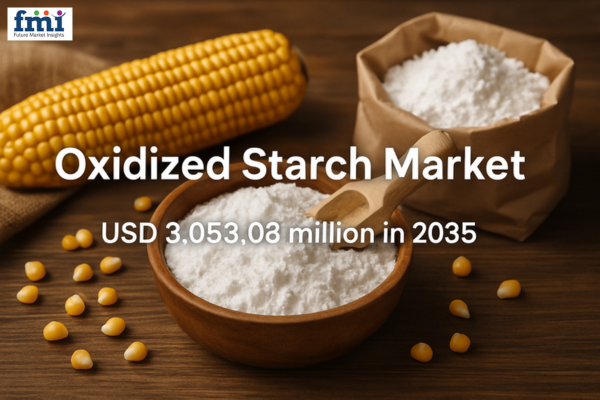
The global oxidized starch market is poised for significant growth, reaching a projected value of approximately USD 3,053.08 million by 2035, up from USD 1,720.99 million in 2025. This reflects a compound annual growth rate (CAGR) of 5.9% from 2025 to 2035, driven by increasing adoption across the food and beverage, pharmaceutical, and paper industries.
Oxidized starch has garnered wide acceptance in multiple sectors due to its enhanced viscosity, film-forming ability, and superior adhesive properties. In the food and beverage industry, it plays a pivotal role in improving texture and stability, especially in sauces, soups, and salad dressings. The pharmaceutical sector leverages oxidized starch as a reliable binder in tablet formulations, while the paper industry values it as a coating and surface treatment agent to enhance printability and gloss. As global industries continue to transition towards eco-friendly and sustainable materials, oxidized starch is emerging as a key ingredient.
Request a Free Sample: https://www.futuremarketinsights.com/reports/sample/rep-gb-3836
Applications of Oxidized Starch in Key End-Use Industries
Oxidized starch, a chemically modified derivative of native starch, is rapidly gaining traction as a multi-functional industrial starch additive. Its enhanced properties, such as improved solubility, lower viscosity, and superior film-forming ability, make it ideal for diverse applications.
Primary Use Cases Include:
- Paper Industry: Acts as a critical coating and surface-sizing agent that enhances printability and paper smoothness.
- Textile Sector: Used in sizing formulations to improve yarn strength, reduce breakage, and enhance weaving efficiency.
- Food Processing: In food-grade oxidized starch usage trends, it functions as a stabilizer and thickener, especially in sauces, puddings, and dairy-based products.
Key Takeaways
- The market is expected to grow at a CAGR of 5.9% between 2025 and 2035.
- Food, paper, and pharmaceutical industries remain the largest end-use segments.
- Increased focus on biodegradable, functional, and clean-label ingredients is a major growth driver.
- Asia Pacific and North America continue to dominate in consumption and innovation.
Significant Developments in Global Sector
- Biotech Advancements: Introduction of enzyme-based oxidation techniques for starch processing is enhancing yield and reducing waste.
- Green Chemistry Processes: Manufacturers are adopting non-toxic oxidizing agents to produce environmentally friendly starch derivatives.
- Automation in Manufacturing: AI and IoT-based process optimization is improving product uniformity and cutting operational costs.
Gain Full Market Perspective – Get the Full Report Today: https://www.futuremarketinsights.com/reports/oxidized-starch-market
Competition Outlook
The market is moderately consolidated with key players competing on innovation, production scale, and cost-efficiency. Some of the top firms are:
- Cargill, Inc.
- Ingredion Incorporated
- Roquette Frères
- Tate & Lyle
- Tereos Group
These companies are heavily investing in R&D and regional expansion to cater to the growing demand from food, pharmaceutical, and industrial segments.
Region-wise Insights
United States
The U.S. market is expanding steadily, supported by robust demand from paper, textile, and processed food sectors. The rise of sustainable packaging and clean-label food products is pushing the use of oxidized starch.
CAGR: 6.1%
United Kingdom
Driven by eco-conscious manufacturing in the paper and textile sectors, the UK is seeing increased adoption of oxidized starch as a biodegradable binder.
CAGR: 5.8%
European Union
Led by Germany, France, and the Netherlands, the EU market thrives on stringent environmental policies and high consumption in paper packaging and pharmaceuticals.
CAGR: 6.0%
Japan
Japan’s focus on quality and hygiene in packaging and food sectors is fostering demand. Local manufacturers are experimenting with high-performance starch derivatives.
CAGR: 5.7%
South Korea
Strong demand from its paper and food processing industries, along with government-led eco-packaging initiatives, make South Korea a lucrative market.
CAGR: 5.9%