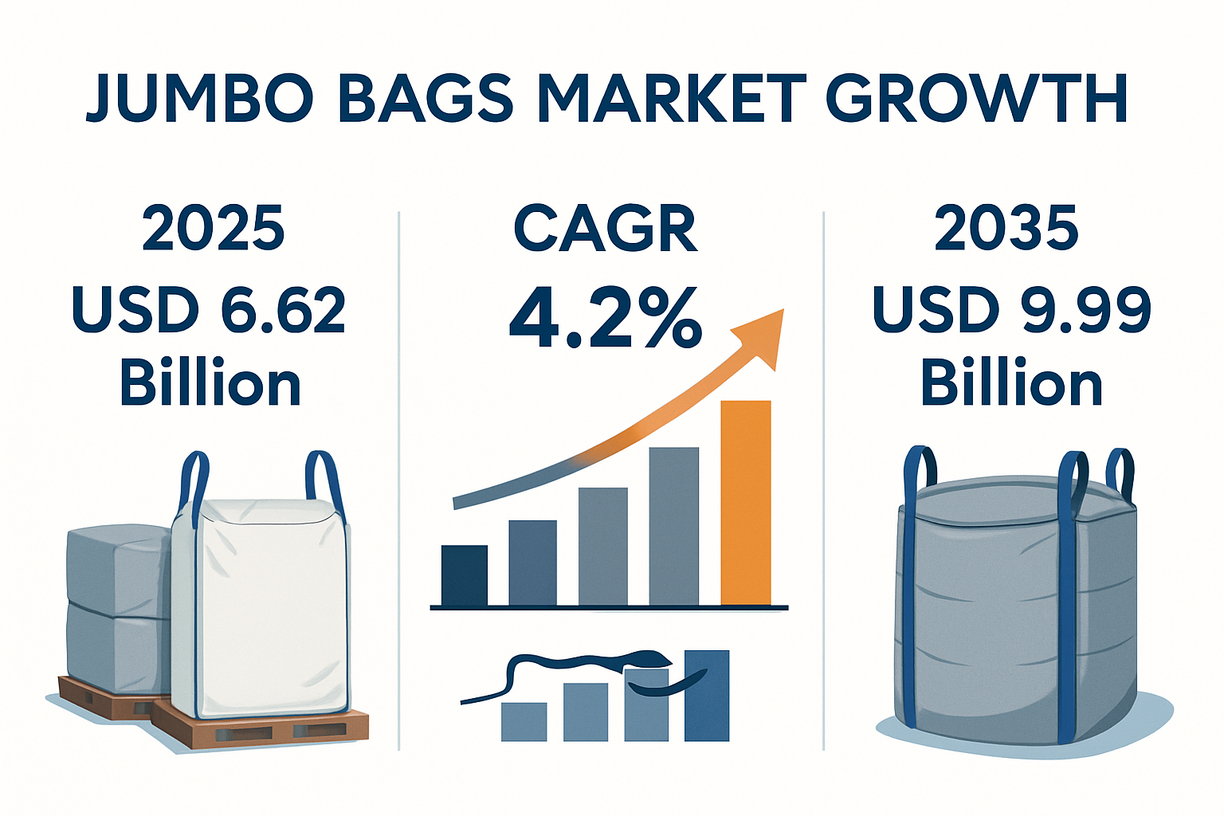
According to Future Market Insights, the jumbo bag market is projected to balloon from $6.62 billion in 2025 to nearly $10 billion by 2035, growing at a steady 4.2% CAGR (FMI Report). Sounds like progress. But that growth isn’t a signal of healthy innovation. It’s a symptom of overstrain, bottlenecks, and desperation for efficiency in a world where logistics are increasingly unreliable.
Also known as FIBCs—Flexible Intermediate Bulk Containers—these oversized sacks are now the unsung workhorses of industrial logistics. They move cement in Brazil, grain in Iowa, chemicals in South Korea. They’re everywhere. But their rise tells a story that should worry anyone paying attention to global supply chains.
Explore Key Trends in the Market: Request Your Sample Report: https://www.futuremarketinsights.com/reports/sample/rep-gb-2060
The Packaging that Carries an Industry
Jumbo bags are cheap, stackable, lightweight—and incredibly versatile. But versatility isn’t the reason they’re seeing a global surge. They’re filling the cracks of a fragmented system. As transportation routes falter and material costs swing wildly, businesses are turning to anything that offers flexibility. That includes bulk packaging that can be quickly filled, reused, and moved without special infrastructure.
These bags aren’t just filling trucks—they’re plugging holes in the foundation.
Surge in Market Demand: Explore Comprehensive Trends and Analysis in Our Full Report: https://www.futuremarketinsights.com/reports/jumbo-bags-market
Sustainability Is Catching Up—Slowly
One thing’s clear: the industry can’t rely on status quo materials much longer. Sustainability isn’t a buzzword anymore—it’s policy, pressure, and public expectation. According to FMI, the market is rapidly shifting toward recyclable and food-grade materials. Companies are finally realizing that ignoring environmental responsibility comes at a price. But the transition is uneven, slow, and—frankly—not nearly urgent enough.
Economic Expansion or Just a Pressure Valve?
Let’s not sugarcoat it. The growth in jumbo bags isn’t all about demand. It’s about coping. Soaring transportation costs, labor shortages, and erratic raw material markets are forcing companies to reinvent how they move goods. And right now, jumbo bags are the duct tape solution holding things together. That’s not innovation. That’s survival.
Reinvent or Break
FMI notes an uptick in higher-grade, coated, and multi-use bag designs. That’s welcome news. But it’s incremental. What the industry needs is transformation—not tweaks. Because the real issue isn’t the bag—it’s what it represents: a logistical system under duress, and a packaging ecosystem that still prioritizes volume over longevity.
Final Take
This market surge isn’t a feel-good story about rising demand. It’s a warning flare.
We are propping up fragile global supply chains with cheap polypropylene and crossed fingers. If we don’t rethink our logistics infrastructure—how we package, move, and store the essentials of modern life—we’ll soon find ourselves not just short on bags, but short on resilience.
Jumbo bags aren’t just a booming commodity. They’re a mirror. And what they reflect is troubling.