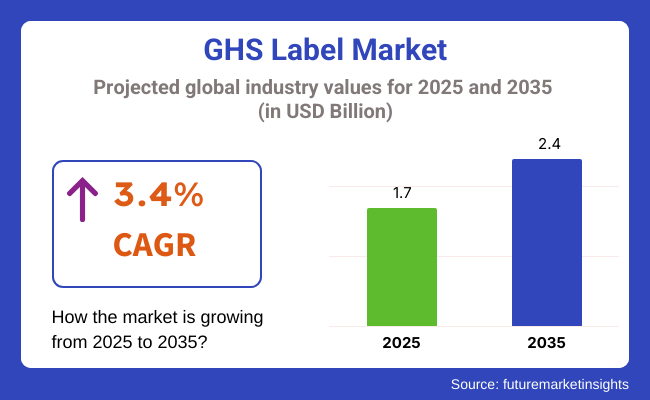
The global harmonized system (GHS) label market is expected to witness steady growth over the forecast period, expected to reach USD 1.7 billion in 2025 and be worth USD 2.4 billion by 2035. This growth reflects a CAGR of 3.4%.
By now, hazard labels should be a no-brainer. A universal safety code. A solved problem. But they’re not. In fact, the way we handle chemical labeling—particularly in the United States—is dangerously outdated, astonishingly fragmented, and woefully complacent.
Gain Valuable Market Knowledge: Request a Sample Report: https://www.futuremarketinsights.com/reports/sample/rep-gb-9942
Labels Are Safety Devices, Not Stickers
Let’s stop pretending otherwise. GHS labels are not decorative tape. They are life-critical warnings. They tell warehouse workers if a drum could explode. They alert hospital staff to chemical burns. They guide customs officials on whether a shipment should be cleared—or seized.
And yet, despite all that’s at stake, labeling compliance in the U.S. remains inconsistent, under-prioritized, and riddled with loopholes.
The labels themselves? Getting smarter, faster, better—according to FMI’s data. The people responsible for applying them? Often undertrained, overworked, or just not paying attention.
Surge in Market Demand: Explore Comprehensive Trends and Analysis in Our Full Report: https://www.futuremarketinsights.com/reports/ghs-labels-market
The Compliance Theater We Keep Playing
For many companies, GHS labeling is a check-the-box exercise. Print. Apply. Forget. But the real problem isn’t just laziness. It’s ignorance—willful or otherwise—of what’s legally and ethically required.
When done right, GHS labels communicate exactly what’s inside a container, how dangerous it is, and how to handle it. When done wrong? They become liabilities. Hazards in their own right. Misinformation masquerading as compliance.
And in a country where enforcement is reactive, not proactive, mistakes often go unnoticed—until someone gets hurt.
Growth Without Accountability Is a Risk Multiplier
Future Market Insights makes it clear: this market isn’t slowing down. Demand is rising across logistics, manufacturing, pharmaceuticals, agriculture—you name it. More chemicals, more global trade, more packaging, more potential for disaster.
So why aren’t we treating this with more urgency?
It’s not a technology problem. The adhesives work. The printers work. The pictograms are internationally standardized. The problem is cultural—a corporate habit of cutting corners and hoping no one notices.
The Bottom Line
The GHS label market is thriving. That’s not the issue. The issue is whether we, particularly in the U.S., are using that growth to improve safety—or just to sell more labels.
Because if we continue to treat labeling as a compliance afterthought instead of a core part of risk management, it’s only a matter of time before that negligence turns deadly.