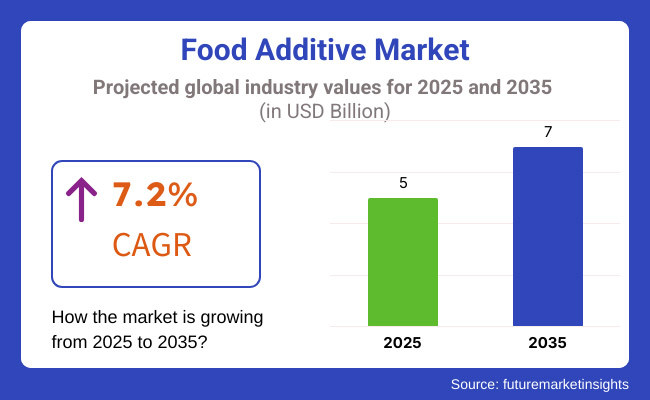
The global food additive market is poised for significant expansion, projected to grow from USD 5 billion in 2025 to USD 7 billion by 2035 at a compound annual growth rate (CAGR) of 7.2%. Driven by evolving consumer preferences, regulatory focus on food safety, and innovation in natural ingredients, food additives have become central to modern food processing. From enhancing flavor and shelf life to improving nutritional content, food additives are vital in meeting the demands of health-conscious and convenience-driven consumers worldwide.
Explore Emerging Market Insights: Request a Sample Report Now: https://www.futuremarketinsights.com/reports/sample/rep-gb-218
Market Trends Highlighted:
Clean Label Movement Gains Momentum: Consumers are increasingly demanding transparency in food production. As a result, manufacturers are replacing synthetic additives with natural alternatives like beetroot for color, rosemary extract for preservation, and stevia for sweetness.
Rising Demand for Functional and Fortified Foods: As health and immunity become a priority post-pandemic, functional additives such as prebiotics, vitamins, antioxidants, and omega-3s are in high demand. These help improve the nutritional value of products without compromising on taste.
Plant-Based and Specialty Diets Driving Innovation: With the rise of vegan, keto, and gluten-free diets, food additive manufacturers are tailoring emulsifiers, thickeners, and binders to suit new food formulations.
Convenience and Processed Foods Surge: Urbanization and busier lifestyles are pushing up the consumption of ready-to-eat meals and snacks. Food additives play a key role in improving texture, appearance, and shelf stability of these products.
Sustainability and Natural Sourcing: Ethical consumption is influencing the food additive supply chain. Companies are investing in sustainable sourcing of ingredients and eco-friendly production methods to meet both environmental goals and consumer expectations.
High Demand for Market Insights: Discover Comprehensive Trends in Our Full Report: https://www.futuremarketinsights.com/reports/food-additives-market
Key Takeaways of the Report:
- The global food additive market will grow at a 7.2% CAGR from 2025 to 2035.
- Market value is set to rise from USD 5 billion in 2025 to USD 7 billion by 2035, indicating rising demand across developed and emerging economies.
- Natural sweeteners, colorants, and clean-label preservatives are expected to outpace synthetic counterparts in growth rate due to shifting consumer behavior.
- The functional additives segment, including fiber, omega-3, and antioxidants, will see strong demand, particularly in wellness and sports nutrition.
- Continued innovation in microencapsulation and nanotechnology will enable more efficient delivery of additives in food products.
Regional Market Outlook:
- North America: The region remains a major contributor, supported by high demand for processed foods, nutraceuticals, and functional beverages. The U.S. leads in clean-label product adoption, with regulatory oversight from the FDA supporting safe additive usage.
- Europe: Driven by stringent EU regulations, the European market is embracing natural food additives and allergen-free formulations. Countries like Germany, France, and Italy are key centers for clean-label and organic food innovation.
- Asia-Pacific: The fastest-growing market, spurred by rapid urbanization, growing middle-class income, and increasing awareness of food quality. China and India are emerging as key hubs for both consumption and production.
- Latin America & Middle East: These emerging regions are experiencing steady growth due to rising packaged food consumption and growing investment in food manufacturing infrastructure. Brazil, Mexico, and the UAE are key focus areas.
Competition Outlook:
The food additive industry is witnessing increasing competition as global and regional players innovate to meet cleaner, healthier, and more functional food expectations. Key strategic moves include mergers and acquisitions, partnerships, and investments in research & development.
Leading Manufacturers
- Chr. Hansen Holding A/S
- Royal DSM N.V.
- BASF SE
- Sensient Technologies Corporation
- Nutra Food Ingredients, LLC
- Dow Chemical Company
- Bell Flavors & Fragrances Incorporated
- Corbion Food Ingredients
- Ajinomoto Food Ingredients
- Food Ingredient Solutions, LLC
 Explore Functional Food Ingredients Industry Analysis: https://www.futuremarketinsights.com/industry-analysis/functional-food-ingredients
Key Segments
By Product Type:
- Flavors & Enhancers
- Sweeteners
- Enzymes
- Emulsifiers
- Shelf-life Stabilizers
- Fat Replacers
- Prebiotics
- Probiotics
- Dietary Fibers
By End-Use Application:
- Bakery & confectionery
- Beverages
- Convenience Foods
- Dairy & Frozen Desserts
- Spices
- Condiments
- Sauces
- Dressings
By Region:
- North America
- Europe
- Middle East
- Africa
- ASEAN
- South Asia
- Asia
- New Zealand
- Australia