It’s sleek. It’s sanitary. It’s sold as science. But the humble facial pump—once an afterthought in skincare—has become a billion-dollar front in the war for cosmetic supremacy. And here’s the uncomfortable truth: while brands obsess over innovation, U.S. regulators are nowhere near the conversation.
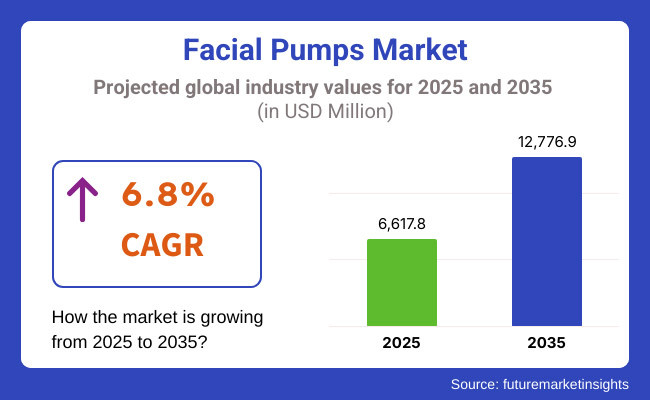
The global facial pumps market is exploding. From $6.6 billion in 2025, it’s projected to nearly double to $12.8 billion by 2035. Why? Clean application, product longevity, aesthetic minimalism—take your pick. Consumers want it, and companies are scrambling to deliver.
Gain Valuable Market Knowledge: Request a Sample Report: https://www.futuremarketinsights.com/reports/sample/rep-gb-13027
America’s Cosmetic Blind Spot
Facial pumps have changed. They’re not just plastic tops on glass jars anymore. Today’s pumps are miniature machines—engineered to preserve formulas, minimize air exposure, and prevent contamination. Some even measure doses down to the microliter.
Yet somehow, in the eyes of U.S. law, they’re still treated like decorative caps.
For decades, cosmetic packaging in the U.S. has flown under the radar. Unlike pharmaceuticals or medical devices, skincare delivery systems aren’t required to undergo rigorous testing. A company can design a sophisticated, airless, refillable pump with zero oversight before it hits the shelf. No inspections. No approvals. No stress.
Rising Interest in Market Trends: Our Detailed Report Provides Essential Insights: https://www.futuremarketinsights.com/reports/facial-pumps-market
Selling Precision Without Proof
According to the FMI report, brands are racing to one-up each other with smarter, sleeker pumps. “Airless” technology is especially in demand—marketed as a way to reduce bacterial risk and keep actives potent for longer. It’s a compelling story. Clean beauty. Sustainable design. Science-backed delivery.
But let’s be honest. How much of it is real, and how much is just clever packaging copy?
Without standards, there’s no way to tell. Companies can make almost any claim about hygiene, precision, or shelf life—without ever proving it. And consumers are left paying premium prices for tech that may or may not deliver what’s promised.
Global Momentum, Domestic Complacency
FMI points to rapid growth across Asia and Europe, where consumer expectations and government oversight often go hand in hand. Meanwhile, in the U.S., brands exploit the regulatory void. The irony? This country is one of the biggest markets for skincare worldwide. It’s also one of the least prepared to manage the risks that come with fast-moving innovation.
Let’s not sugarcoat it. The U.S. is coasting on outdated laws while the rest of the world upgrades. That’s not just shortsighted—it’s dangerous.
The Consequences of Indifference
This isn’t a hypothetical problem. Packaging affects product stability. A malfunctioning pump can oxidize ingredients, introduce bacteria, or dispense the wrong amount of a potent active. Over time, that’s not just waste—it’s a liability.
What happens when a high-end serum causes a rash or stops working two weeks in because the pump failed? Right now, consumers are left to guess. And regulators? They’re still catching up.
The Bottom Line
We’re not just talking about bottles. We’re talking about credibility.
If facial pumps are the future of skincare—and the numbers say they are—then it’s time the U.S. treated them like the technology they’ve become. The FMI data makes one thing clear: the market is accelerating. But the oversight? It’s stuck in the past.
And in an industry built on trust, that kind of disconnect isn’t just irresponsible. It’s unsustainable.