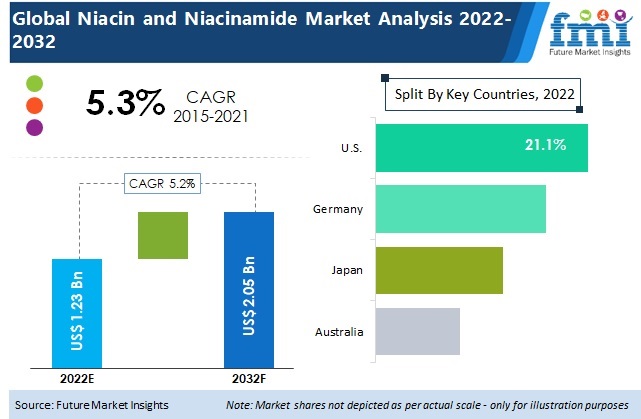
The global niacin and niacinamide market is expected to witness steady growth from USD 1.3 billion in 2025 to USD 1.8 billion in 2035 with a CAGR of 3.1%. These compounds are used extensively in a variety of formulations, such as dietary supplements, topical creams, and oral tablets, thus broadening their scope of application.
The Niacin and Niacinamide Market is gaining significant traction globally due to its wide applications in the pharmaceutical, food, personal care, and animal nutrition industries. These two forms of vitamin B3 offer essential health benefits, driving their demand among both end-users and manufacturers. As health awareness continues to rise, and the importance of vitamin supplementation grows, the market has seen a noticeable increase in investments and innovations.
Niacin, also known as nicotinic acid, and niacinamide or nicotinamide, play a crucial role in metabolism, cellular repair, and skin health. As consumer preference shifts toward preventive healthcare and dietary supplements, the Niacin and Niacinamide Market is expected to experience robust expansion over the coming years.
Get Sample Report: – https://www.futuremarketinsights.com/reports/sample/rep-gb-4521
Size & Trends
The Niacin and Niacinamide Market has grown steadily, influenced by increased demand from the nutraceutical and cosmetics industries. Recent years have seen a substantial shift in how consumers and businesses approach wellness, sustainability, and bioavailability in supplements.
- Global market size reached multi-billion-dollar levels by 2024.
- Forecasts predict continuous growth with a CAGR in the mid-single digits through 2030.
- The rise of vegan and plant-based supplements has fueled product innovation.
- Demand from skincare products is growing, with niacinamide gaining popularity for its anti-inflammatory and anti-aging properties.
- Expanding use of fortified food products in developing economies adds to market potential.
Challenges and Opportunities
While the Niacin and Niacinamide Market holds promising prospects, it is not without its hurdles. Raw material price fluctuations and strict regulatory environments can slow growth or restrict innovation. However, many opportunities lie in untapped markets and emerging technologies.
Key Challenges:
- Inconsistent quality and purity of raw materials impact end-product efficacy.
- Regulatory scrutiny in different regions adds complexity to product approvals.
- Consumer skepticism about synthetic vitamins in favor of natural alternatives.
Emerging Opportunities:
- Rising demand for clean-label and transparent sourcing practices.
- Increased investment in R&D for bio-based production of niacin and niacinamide.
- Expanding e-commerce channels enable wider product reach and niche branding.
- Growth in elderly populations worldwide boosts demand for B3 supplements.
Market Share by Geographical Region
Regional dynamics significantly affect the Niacin and Niacinamide Market, with varying demand across continents. Developed and emerging markets both contribute uniquely to the industry landscape.
North America:
- Strong demand due to a well-established dietary supplement industry.
- High adoption of functional foods and personal care products.
Europe:
- Regulatory challenges exist, but consumer awareness supports steady growth.
- Popularity of organic skincare contributes to niacinamide market expansion.
Asia-Pacific:
- Fastest-growing region due to rising disposable incomes and growing health awareness.
- China and India serve as major production and consumption hubs.
Latin America and Middle East & Africa:
- Gradual market development with growing health infrastructure.
- Potential for expansion due to increasing adoption of fortified foods and global partnerships.
Top Companies
The competitive landscape of the Niacin and Niacinamide Market is composed of both global conglomerates and specialized manufacturers. Key players focus on capacity expansion, strategic mergers, and product innovation.
- Lonza Group AG: Known for its diverse portfolio in vitamins and nutritional ingredients.
- BASF SE: Offers premium niacinamide for cosmetics and dietary supplements.
- Zhejiang NHU Company Ltd.: A major player in China’s vitamin production industry.
- Brother Enterprises Holding Co., Ltd.: Focuses on fermentation-based vitamin B3 production.
- Foodchem International Corporation: Supplies high-grade niacin and niacinamide for food applications.
Strategic Highlights:
- Many companies are enhancing production facilities to meet rising global demand.
- Collaboration with cosmetic and pharmaceutical brands is growing.
- Sustainability and traceability are becoming key competitive differentiators.
Explore In-Depth Analysis-Click Here to Access the Report:- https://www.futuremarketinsights.com/reports/niacin-and-niacinamide-market
Segmentation Outlook
The Niacin and Niacinamide Market is segmented based on form, application, and end-user industries. Understanding these segments helps stakeholders tailor their strategies and investments.
By Form:
- Powder: Most widely used due to stability and ease of formulation.
- Liquid: Preferred in certain cosmetic and pharmaceutical applications.
By Application:
- Pharmaceuticals: Used in treatment of pellagra and cholesterol management.
- Personal Care: Niacinamide is a staple ingredient in serums and creams.
- Animal Nutrition: Incorporated in feed additives for poultry and livestock.
- Food & Beverage: Used in fortified products and health drinks.
By End-User:
- Healthcare Providers
- Nutraceutical Companies
- Cosmetic Manufacturers
- Feed Producers