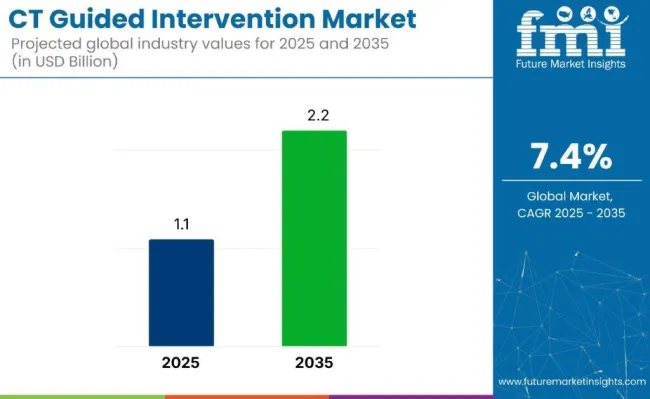
The CT guided intervention market is expected to record a valuation of USD 1.1 billion in 2025 and USD 2.2 billion by 2035, at a CAGR of 7.4% during the forecast period. The growth is being driven by the increasing demand for minimally invasive procedures and advancements in CT technology, which allow for precise diagnostics and real-time guidance during interventions. The rise in the aging population, combined with a higher incidence of chronic diseases such as cancer, cardiovascular diseases, and neurological disorders, is contributing to market expansion.
The CT guided intervention market has seen rapid expansion over the past decade. With rising incidences of chronic diseases, particularly cancer and cardiovascular conditions, the demand for precise, minimally invasive procedures is escalating. CT (Computed Tomography) guided interventions offer accuracy in diagnosis and targeted treatment, especially in procedures such as biopsies, drainage, ablations, and nerve blocks.
As healthcare systems strive to reduce surgery time, patient recovery periods, and overall treatment costs, the role of CT-guided techniques becomes increasingly critical. Hospitals and clinics are adopting these interventions not only for their precision but also for enhancing patient safety.
Get Sample Report: – https://www.futuremarketinsights.com/reports/sample/rep-gb-22344
Market Trends
Several trends are reshaping the CT guided intervention market, from technology enhancements to patient-centered care approaches. Some of the key developments include:
- Increased adoption of AI integration in CT systems, enhancing imaging quality and real-time decision-making.
- Growing preference for outpatient care, as minimally invasive techniques reduce the need for prolonged hospital stays.
- Hybrid operating rooms that combine real-time imaging with surgical capabilities are becoming more prevalent.
- Rising awareness among clinicians and patients regarding the benefits of CT-guided interventions in achieving better outcomes.
- Shift toward personalized medicine, driving demand for interventions that are targeted, fast, and efficient.
These trends reflect the industry’s push toward innovation, efficiency, and improved clinical performance.
Challenges and Opportunities
While the CT guided intervention market holds immense promise, it also faces challenges that could affect its growth trajectory.
Challenges:
- High costs of CT equipment and associated infrastructure limit access, especially in emerging markets.
- Radiation exposure risks, which call for advanced shielding and low-dose technology development.
- Limited availability of skilled professionals who can perform complex CT-guided procedures.
- Regulatory and reimbursement issues in several regions, making market penetration difficult.
Opportunities:
- Technological breakthroughs in low-radiation CT imaging open doors for safer interventions.
- Expansion into rural and underdeveloped areas through mobile CT units and telehealth solutions.
- Partnerships and collaborations between medical device companies and healthcare providers to deliver value-based care.
- Increased funding in research and development is pushing the innovation of next-gen CT intervention tools.
Despite the obstacles, the potential for growth remains strong as healthcare evolves toward precision-based interventions.
Key Points:
- The CT guided intervention market is primarily driven by the increasing need for precision in diagnostic and therapeutic procedures.
- Technological innovation, such as AI and robotics, is significantly improving the quality and speed of CT-guided interventions.
- Patient demand for less invasive, quicker recovery procedures is boosting market acceptance.
- Hospitals are investing in hybrid surgical suites, integrating real-time CT guidance for advanced surgeries.
- Reimbursement policies are slowly improving, particularly in North America and Europe, making the procedures more accessible.
- Start-ups and established players alike are focusing on product development that offers high accuracy with low radiation exposure.
Key Regional Insights
Regional dynamics play a pivotal role in shaping the CT guided intervention market globally. Here’s a regional breakdown:
- North America leads the market, fueled by advanced healthcare infrastructure, favorable reimbursement policies, and early adoption of new technologies.
- Europe follows closely, with strong investments in research and increased demand for minimally invasive procedures.
- Asia-Pacific is the fastest-growing region, driven by rising healthcare spending, aging populations, and an increase in chronic disease prevalence.
- Latin America and the Middle East & Africa are gradually adopting CT-guided technologies, although challenges such as limited access and cost barriers remain.
Top Companies
Several major players dominate the CT guided intervention market, each contributing to innovation and widespread adoption. Leading companies include:
- GE Healthcare – Known for advanced imaging platforms and integrated solutions for intervention.
- Siemens Healthineers – Offers high-resolution CT systems with AI capabilities.
- Philips Healthcare – Focuses on patient-friendly CT systems with reduced radiation dose.
- Canon Medical Systems – Renowned for real-time imaging accuracy and user-friendly interfaces.
- Medtronic – Provides intervention tools used in CT-guided procedures for oncology and neurology.
- Boston Scientific – Develops specialized instruments for image-guided therapy.
These companies are actively expanding through mergers, partnerships, and continuous product innovation.
Explore In-Depth Analysis-Click Here to Access the Report:- https://www.futuremarketinsights.com/reports/ct-guided-intervention-market
Segmentation Outlook
Understanding the market segmentation helps in identifying growth opportunities within the CT guided intervention market. The segmentation is typically categorized as:
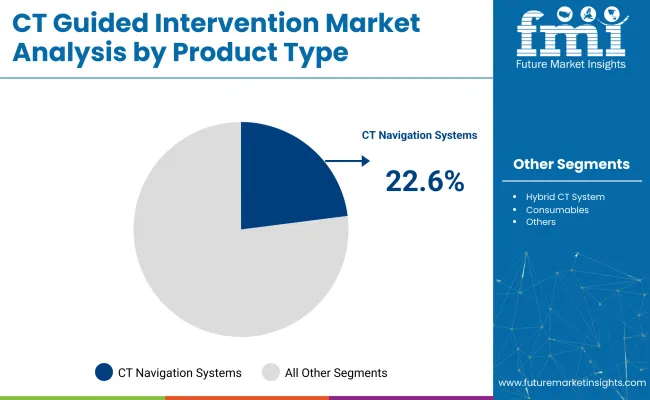
- By Product Type:
- CT Scanners
- Needles, Probes, and Catheters
- Software & Accessories
- By Application:
- Oncology
- Cardiology
- Neurology
- Orthopedics
- Pain Management
- By End User:
- Hospitals
- Ambulatory Surgical Centers
- Specialty Clinics
- Diagnostic Imaging Centers
- By Region:
- North America
- Europe
- Asia-Pacific
- Latin America
- Middle East & Africa