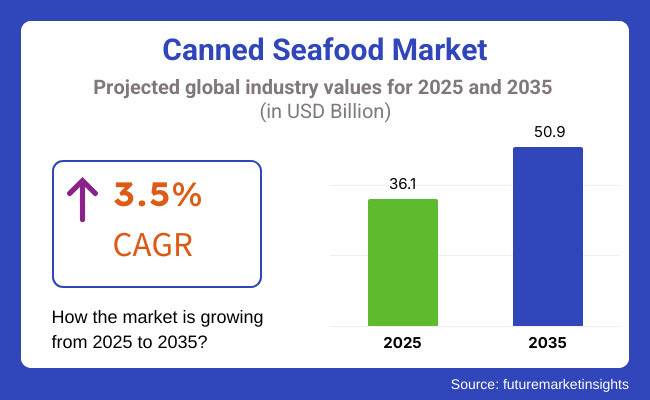
 The global recycled canned seafood market is projected to grow from USD 36.1 billion in 2025 to USD 50.9 billion by 2035, with a steady CAGR of 3.5%. This growth is fueled by increasing consumer demand for affordable, protein-rich, and sustainable food options. Rising awareness around eco-friendly packaging and sourcing, combined with the convenience of canned products, has created fertile ground for innovation and market expansion across regions.
Discover How Market Trends Are Shaping Industries: Access Your Sample Report: https://www.futuremarketinsights.com/reports/sample/rep-gb-11047
Market Trends Highlighted:
- Sustainability as a Core Demand Driver: Eco-conscious consumers are gravitating towards canned seafood packaged in BPA-free containers and sourced from certified sustainable fisheries, particularly in regions like the EU and UK.
- Premium and Gourmet Offerings on the Rise: From organic, wild-caught tuna to artisan sardines in olive oil, brands are capitalizing on consumer appetite for high-quality, ready-to-eat options.
- Convenience and Online Availability Fuel Growth: The proliferation of digital grocery platforms and meal kit services is making canned seafood more accessible, particularly in urbanized markets like the US and Japan.
- Localization of Flavors and Innovation: In South Korea and Japan, local flavor adaptations like kimchi tuna and canned squid cater to regional palates, while maintaining nutritional value and long shelf life
Expanding Market Need: Access Our Full Report for In-Depth Analysis and Trends: https://www.futuremarketinsights.com/reports/canned-seafood-market
Key Takeaways of the Report:
- Global Market Size: Estimated at USD 36.1 billion in 2025 and projected to reach USD 50.9 billion by 2035.
- Growth Rate: CAGR of 3.5% from 2025 to 2035.
- Leading Growth Region: South Korea leads with the highest CAGR of 3.8%, followed closely by the EU at 3.7%.
- Health-Driven Consumption: Consumers are increasingly opting for protein-rich, low-fat seafood alternatives, especially those responsibly sourced and packaged.
- Technological Integration: The role of e-commerce and smart supply chains is expanding market reach and accessibility.
Regional Market Outlook:
- United States:
A mature yet steadily growing market with a CAGR of 3.6%. The US market thrives on premium offerings, health-focused innovations, and expansive retail networks. Demand is centered around tuna, salmon, sardines, and crab meat. - United Kingdom:
With a 3.4% CAGR, the UK market is supported by price-conscious shoppers and regulatory emphasis on sustainable sourcing. New product launches focus on ready-to-eat seafood meals and value-added ingredients. - European Union:
Canned seafood is deeply embedded in Mediterranean culture. The EU market is seeing a boom in gourmet and artisanal products with a CAGR of 3.7%. Consumers are prioritizing preservative-free, certified seafood. - Japan:
Japan’s 3.5% CAGR is driven by a strong preference for high-quality, long-shelf-life seafood. Traditional preservation methods and innovative packaging cater to busy urban lifestyles and convenience seekers. - South Korea:
Leading with a 3.8% CAGR, South Korea’s market is dominated by flavored canned tuna, driven by affordability and localized tastes. The home-cooking and delivery trends are major growth enablers.
Competition Outlook:
The global recycled canned seafood market is highly competitive, with key players shifting toward sustainability, premiumization, and product diversification. Leading brands are introducing wild-caught and organic offerings to meet evolving consumer expectations. Certifications like MSC are now standard for competitive positioning, particularly in the EU and UK. Companies are also leveraging digital sales platforms and strategic partnerships with retail and meal kit providers to strengthen distribution. Innovations in flavoring, packaging, and portion control are helping brands cater to niche markets, from health-focused consumers to busy professionals.
Company Profile
-
- Nueva Pescanova
- Marine Harvest ASA
- Thai Union Frozen Products
- Royal Greenlands
- StarKist Co.
- Nippon Suisan Kaisha Ltd.
- Maruha Nichiro Corporation
- Icicle Seafoods Inc.
- LDH (La Doria) Ltd.
- Wild Planet Foods
 Explore Seafood Industry Analysis: https://www.futuremarketinsights.com/industry-analysis/seafood
Key Segments
By Product Type:
- Caviar
- Mackerel
- Salmon
- Sardines
- Tuna
By Sales Channel:
- Hypermarkets/Supermarkets
- Convenience Stores
- Independent Grocery Stores
- Specialty Stores
- Online Retail
By Region:
- North America
- Latin America
- Western Europe
- Eastern Europe
- East Asia
- South Asia Pacific
- Middle East and Africa