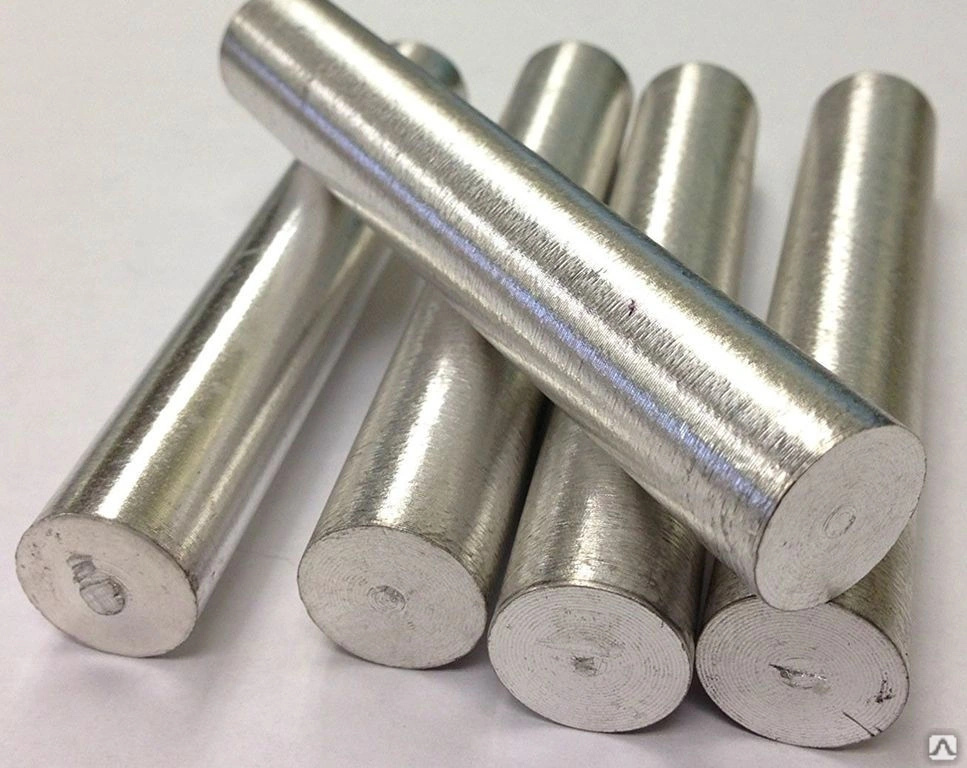
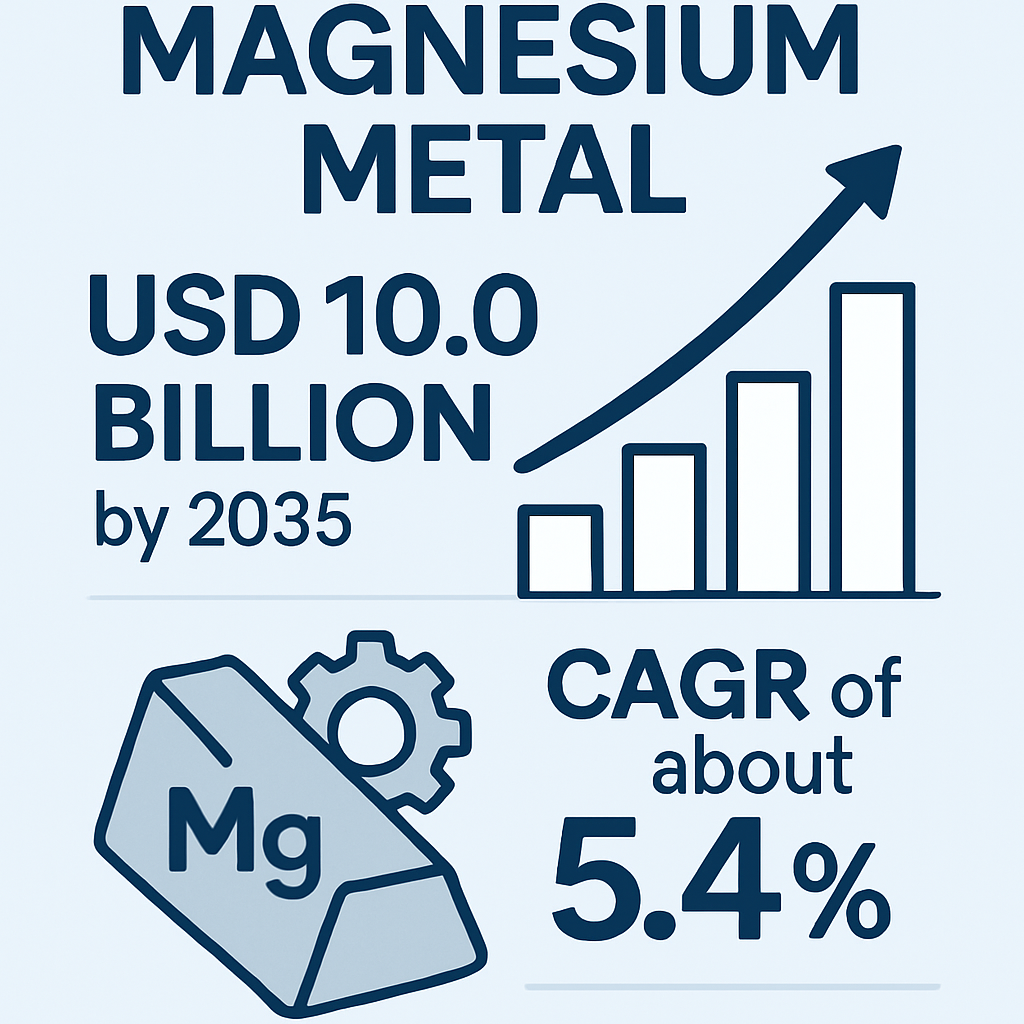
The magnesium metal market is projected to grow steadily from USD 5.89 billion in 2025 to approximately USD 10.0 billion by 2035, registering a CAGR of 5.4% during the forecast period. This growth is primarily driven by the rising demand for lightweight, high-strength materials across industries such as automotive, aerospace, and electronics, where magnesium plays a vital role in enhancing performance, fuel efficiency, and component durability.
Understand Market Trends: Get Your Sample Report! https://www.futuremarketinsights.com/reports/sample/rep-gb-1550
Market Trends Highlighted:
- Lightweighting in Automotive Industry:
Magnesium alloys are increasingly being adopted by automotive OEMs to reduce vehicle weight and enhance fuel efficiency, especially in electric vehicles (EVs) and hybrid models. - Rising Use in Aerospace Components:
Magnesium’s high strength-to-weight ratio makes it ideal for aerospace parts, including aircraft interiors, gear housings, and brackets, supporting fuel economy and payload capacity. - Magnesium in Battery Technology:
Research into magnesium-ion batteries is gaining traction due to their potential advantages over lithium-ion systems, such as higher energy density and improved safety. - Demand for Green and Recyclable Materials:
Magnesium is 100% recyclable, making it a favorable material in sustainability-driven manufacturing strategies. - Expansion of Die Casting Applications:
The metal’s ease of processing makes it a preferred material for precision die-casting, especially for automotive, electronics housings, and industrial machinery parts.
Recent Developments:
- Strategic Investments in Production Capacity:
Major producers are expanding smelting and refining capabilities, especially in China and the U.S., to meet increasing global demand. - Government Push for Critical Minerals:
Magnesium has been identified as a strategic or critical mineral in several countries (including the U.S. and EU), triggering supportive policy frameworks to boost domestic supply chains. - Alloy Innovations:
Recent breakthroughs in magnesium-aluminum and magnesium-rare earth alloys are unlocking new possibilities in strength, corrosion resistance, and thermal stability. - Vertical Integration by Market Leaders:
Companies are investing in upstream mining operations and downstream alloy processing to reduce dependency on imports and secure stable raw material access.
Rising Demand for Market Data: Our Full Report Offers Deep Insights and Trend Analysis! https://www.futuremarketinsights.com/reports/magnesium-metal-market
Key Takeaways of the Report:
- Automotive and aerospace remain the dominant sectors, accounting for over 60% of total consumption.
- Demand for magnesium alloys continues to outpace pure metal, thanks to their superior properties in structural and mechanical applications.
- Asia Pacific leads global consumption and production, while North America and Europe focus on supply chain diversification and innovation.
Market Drivers:
- Rising EV and Lightweight Vehicle Production:
Magnesium parts are helping automakers meet emission targets and improve battery range through vehicle weight reduction. - Growing Aircraft Manufacturing:
Demand for fuel-efficient aircraft and lightweight interior components is fueling magnesium usage. - Environmental Regulations:
Policies encouraging sustainable and recyclable materials are pushing industries to adopt magnesium over heavier, less eco-friendly metals. - Advancement in Magnesium Battery Research:
Although still in R&D stages, magnesium-ion battery technology has the potential to transform the energy storage sector. - Expansion in Electronics and Industrial Machinery:
High thermal conductivity and dimensional stability make magnesium ideal for electronics casings, laptops, and machinery components.
Regional Insights:
Asia Pacific:
Asia Pacific dominates the magnesium metal market, led by China, which is both the largest producer and consumer. Rising automotive production, infrastructure growth, and heavy industrialization in India, Japan, and South Korea are also contributing to strong regional demand.
North America:
The region is seeing increasing investments in EV production, aerospace innovation, and defense. U.S. policies promoting critical mineral independence are pushing magnesium exploration and processing projects.
Europe:
Europe’s stringent carbon emission norms and circular economy goals are promoting the adoption of lightweight, recyclable materials like magnesium, especially in Germany, France, and the UK.
Latin America & Middle East:
These regions are emerging as potential magnesium suppliers due to untapped mineral reserves, and governments are seeking to attract foreign direct investment in mining and metal processing.
Competition Outlook (In Points):
- Market Share Concentration: The market is moderately consolidated, with China controlling a significant share of global magnesium production capacity.
- Innovation & R&D: Leading firms are focused on developing advanced alloys, optimizing energy usage during processing, and reducing costs associated with magnesium extraction.
- Strategic Collaborations: Companies are forming partnerships with automotive OEMs and defense contractors to secure long-term magnesium alloy supply agreements.
- Resilience Planning: In response to global supply disruptions, major players in Europe and North
General & Advanced Materials Industry Analysis: https://www.futuremarketinsights.com/industry-analysis/general-and-advanced-materials
Key Players
- USA Magnesium LLC
- VSMPO-Avisma Corp.
- Alliance Magnesium
- Latrobe Magnesium
- Shanghai Sunglow Investment (Group) Co., Ltd.
- Solikamsk Desulphurizer Works (SZD)
- Nippon Kinzoku Co. Ltd.
- Esan Eczacibasi
- Western Magnesium Corp.
- Regal Metal
Segmentation
By Product Type:
The segmentation is into pure magnesium and magnesium alloys.
By Application Type:
The segmentation is into die-casting, aluminum alloys, metal reduction, desulphurization, and others.
By Region:
The report covers North America, Latin America, Europe, Asia Pacific, and the Middle East & Africa (MEA).