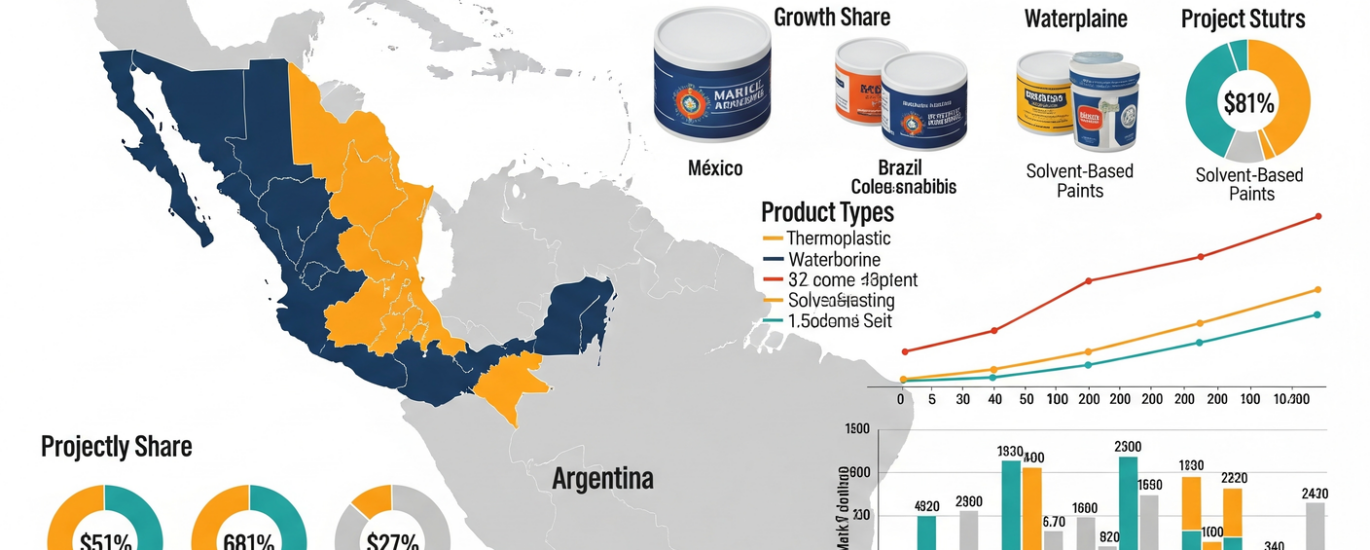
Introduction: Beyond the Basics of Road Marking Paints in Latin America
The Latin America road marking paint and coating market is often analyzed through the lens of economic activity, infrastructure investment, and regulatory developments. However, one of the least discussed but most critical factors shaping the performance and demand of these materials is the region’s climatic diversity. Stretching from the arid northern deserts of Chile to the lush tropical expanses of the Amazon and the temperate southern plains of Argentina, Latin America presents a wide range of environmental conditions that influence how road marking paints are formulated, selected, and applied. This article explores how climate-driven challenges across Latin America are creating unique demands for weather-specific, high-performance coatings, transforming procurement strategies, and driving innovation in the regional traffic paint market.
𝐌𝐚𝐤𝐞 𝐈𝐧𝐟𝐨𝐫𝐦𝐞𝐝 𝐃𝐞𝐜𝐢𝐬𝐢𝐨𝐧𝐬 – 𝐀𝐜𝐜𝐞𝐬𝐬 𝐘𝐨𝐮𝐫 𝐒𝐚𝐦𝐩𝐥𝐞 𝐑𝐞𝐩𝐨𝐫𝐭 𝐈𝐧𝐬𝐭𝐚𝐧𝐭𝐥𝐲! https://www.futuremarketinsights.com/reports/sample/rep-gb-18693
The Climatic Puzzle: Why One Paint Doesn’t Fit All
Road markings are more than mere visual guides; they are safety-critical components that must remain legible and reflective despite extreme weather. In Latin America, this demand becomes complex when factoring in a wide range of climatic zones. In regions like the Atacama Desert in northern Chile—considered the driest place on Earth—paints face intense UV radiation and heat. Traditional solvent-based paints tend to degrade quickly under such prolonged exposure. Conversely, in the Amazon basin of Brazil, road paints are challenged by high humidity, heavy rainfall, and mold, necessitating formulations that resist moisture penetration and hydrolysis.
Further south, cities in Argentina like Bariloche experience cold winters, where freeze-thaw cycles can damage both road surfaces and coatings. Here, thermoplastic paints with flexible binders are favored for their ability to expand and contract with temperature variations. Meanwhile, Peru’s Andean regions, which sit at high altitudes, combine both UV intensity and cooler temperatures—demanding a dual-resilience formulation. These variances highlight why a one-size-fits-all approach to road marking paint is neither effective nor sustainable across the continent.
Innovation in Formulations: A Market Driven by Extremes
Faced with these challenges, manufacturers operating in Latin America have been compelled to develop or adapt climate-resilient formulations. In Brazil, for example, several infrastructure projects have shifted to waterborne acrylic paints blended with reflective glass beads and UV stabilizers, particularly in areas with high rainfall and sunlight.
Chile presents a contrasting example where thermoplastic paints, known for their superior adhesion and resistance to wear, are preferred in northern mining corridors. Here, traffic markings must withstand abrasive dust and daily temperature swings exceeding 30°C. Local suppliers have collaborated with international chemical firms to introduce advanced resins with elevated softening points and enhanced reflectivity—specially tailored for desert climates.
𝐔𝐧𝐥𝐨𝐜𝐤 𝐂𝐨𝐦𝐩𝐫𝐞𝐡𝐞𝐧𝐬𝐢𝐯𝐞 𝐌𝐚𝐫𝐤𝐞𝐭 𝐈𝐧𝐬𝐢𝐠𝐡𝐭𝐬 – 𝐄𝐱𝐩𝐥𝐨𝐫𝐞 𝐭𝐡𝐞 𝐅𝐮𝐥𝐥 𝐑𝐞𝐩𝐨𝐫𝐭 𝐍𝐨𝐰: https://www.futuremarketinsights.com/reports/road-marking-paint-and-coating-industry-analysis-in-latam
These innovations are not merely technical tweaks but strategic responses to environmental extremes. They offer better lifecycle cost efficiency, reduce the frequency of maintenance, and improve road safety—a critical point for countries with rising vehicle ownership and expanding transport networks.
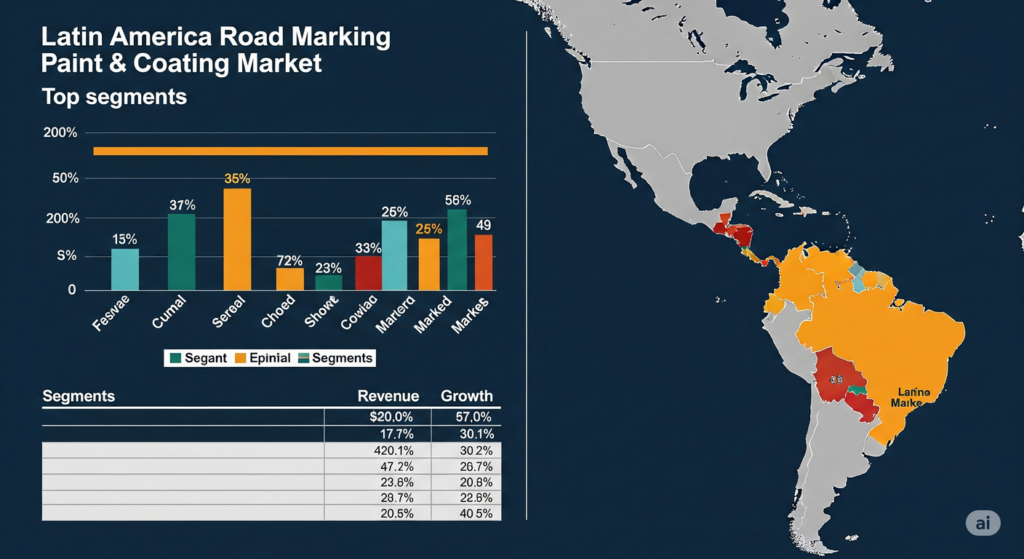
Regional Demand Dynamics: Climate as a Market Differentiator
While infrastructure investments continue to drive overall growth in the Latin America road striping material market, climate is emerging as a key differentiator in regional demand. In Argentina’s Pampas, road agencies are increasingly specifying alkyd-based solvent paints for rural routes where reapplication schedules are more lenient, and durability takes precedence over reflectivity. In contrast, Mexico’s central plateau, which combines elevation with seasonal rains, shows growing demand for cold plastic coatings, particularly on highways with high-speed traffic.
These choices are not incidental. According to Future Market Insights, the road marking coatings segment in Latin America is projected to grow at a compound annual growth rate (CAGR) of 5.9% between 2025 and 2035, with climate-resilient variants making up a growing share. Customized regional demand forecasts indicate that while Brazil and Mexico remain the volume leaders, countries like Colombia and Peru are expected to see the fastest growth in demand for adaptive and durable coatings—driven largely by efforts to improve connectivity in challenging terrains.
Policy and Procurement: Adapting Standards to Geography
Government procurement policies are beginning to reflect this complexity. In Chile, the Ministry of Public Works has revised its national road marking specifications to include climate-specific performance tests, such as accelerated UV exposure and anti-skid properties under wet conditions. Similarly, Brazil’s Department of Transport has introduced localized guidelines for reflective paint performance in rain-heavy states like Amazonas and Pará.
These adaptations have far-reaching implications. They not only guide material selection but also influence bidding processes, supplier qualifications, and long-term budgeting for maintenance. Several municipalities in Peru, for instance, now require contractors to submit weather-adapted formulation plans when bidding on rural or high-altitude highway projects. This trend suggests a growing alignment between environmental realities and infrastructure strategy across Latin America.
Coatings, Inks, Adhesives & Sealants Industry Analysis: https://www.futuremarketinsights.com/industry-analysis/coatings-inks-adhesives-and-sealants
Conclusion: Rethinking Market Strategy in a Climate-Driven Landscape
Latin America’s road marking paint and coating market cannot be understood solely through conventional metrics of volume and regulation. Climate diversity—ranging from tropical storms and equatorial heat to frost and desert winds—plays an increasingly central role in shaping demand, formulation, and performance criteria. Stakeholders who fail to consider these environmental variables risk product underperformance, higher maintenance costs, and compromised road safety.
By contrast, manufacturers and policymakers who embrace a climate-sensitive approach stand to gain competitive and operational advantages. From custom resins for desert durability to reflective additives for rainy urban zones, the future of road safety in Latin America lies in innovation aligned with geography. As infrastructure development continues to surge across the continent, climate will remain not just a background factor, but a decisive force in how road marking paints and coatings are created, applied, and maintained.