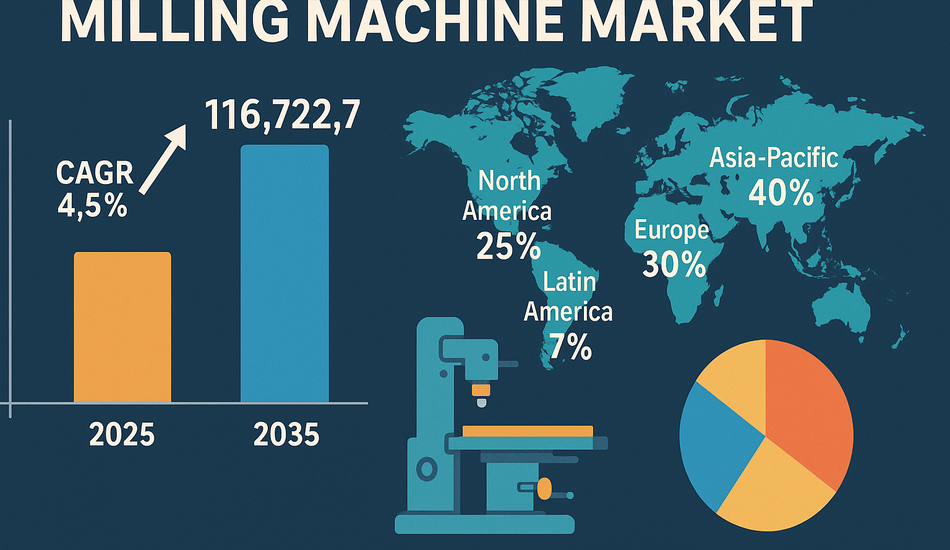
The global milling machine market is poised for notable growth over the next decade, advancing from USD 75,161 million in 2025 to USD 116,722.7 million by 2035, reflecting a steady CAGR of 4.5%. This promising trajectory is underpinned by the worldwide shift toward digital manufacturing, automation, and the rising demand for precision engineering across diverse industries.
Precision Engineering Fueling Industrial Progress
Milling machines are foundational to modern manufacturing. From the automotive and aerospace industries to electronics, medical equipment, and general fabrication, these machines play a critical role in shaping a wide range of materials including metal, plastic, and wood with exceptional accuracy. Their capacity to produce high-tolerance components makes them indispensable for companies that prioritize quality, performance, and consistency.
With the ongoing digital transformation in manufacturing, next-generation milling solutions—featuring Computer Numerical Control (CNC), multi-axis machining, and IoT connectivity—are redefining productivity standards. The adoption of these advanced systems enables businesses to achieve higher throughput, superior product finishes, and reduced waste.
Gain Valuable Insights from Industry Experts to Shape Your Growth Strategies. Access our Sample Report Now: https://www.futuremarketinsights.com/reports/sample/rep-gb-16589
North America at the Forefront of Smart Milling Adoption
Regionally, North America is projected to maintain a significant share of the global milling machine market during the forecast period. The United States, in particular, is seeing accelerated integration of automated milling systems across key sectors like aerospace, automotive, and healthcare. Government support for Industry 4.0 initiatives and the proliferation of smart factory concepts are further stimulating demand for state-of-the-art milling technologies.
Technological Advances Elevating Milling Capabilities
Modern milling equipment is no longer limited to conventional mechanical functions. Today’s machines are sophisticated, data-driven assets equipped with embedded sensors, remote diagnostics, and real-time monitoring tools. Integration with IoT networks empowers manufacturers with predictive maintenance capabilities, drastically cutting downtime and optimizing production flow.
In response to market demands for flexibility, manufacturers are designing highly customizable milling systems. Whether for high-volume automotive parts, delicate dental components, or heavy-duty aerospace applications, these machines deliver tailored solutions to match industry-specific needs.
Market Drivers and Challenges
The market’s upward trend is primarily driven by three factors: increasing demand for high-precision machining, automation of production lines, and continual technological enhancements. However, certain challenges persist. The substantial initial investment required for advanced milling systems can deter small and medium-sized enterprises (SMEs) from upgrading legacy equipment. Additionally, the growing complexity of smart milling machines necessitates a skilled workforce proficient in operating CAD/CAM software and managing IoT-driven maintenance. Addressing this skill gap remains a top priority for manufacturers and industry stakeholders alike.
Browse Full Report Here: https://www.futuremarketinsights.com/reports/milling-machine-market
Delivering High Performance and Durability
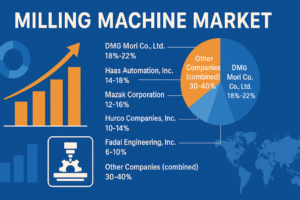
Leading players such as
- DMG Mori Co., Ltd.,
- Haas Automation, Inc.,
- Mazak Corporation,
- Hurco Companies, Inc.,
- Fadal Engineering, Inc.
continue to push the boundaries of innovation. Their cutting-edge CNC milling machines combine high-speed cutting with robust structural designs, delivering durable solutions that withstand heavy-duty tasks without compromising surface finish or dimensional precision.
These attributes make modern milling machines invaluable assets for industries that demand consistency, accuracy, and efficiency, solidifying their role as the backbone of smart manufacturing environments.
Regional Highlights
Beyond North America, other regions are contributing to the market’s dynamic landscape:
- Latin America is experiencing stable growth driven by industrial expansion and cost-effective CNC adoption.
- Western Europe maintains a mature, automation-focused market.
- Eastern Europe benefits from increased industrial investments and manufacturing relocations.
- East Asia, led by China, Japan, and South Korea, remains the fastest-growing region due to significant spending in automotive and electronics sectors.
- South Asia & Pacific see rising demand, especially in India and ASEAN countries, spurred by infrastructure projects and local production initiatives.
- The Middle East & Africa are gradually increasing investments to diversify their industrial capabilities.
Latest Manufacturing Equipment Reports: https://www.futuremarketinsights.com/industry-analysis/manufacturing-equipment
Conclusion: Embracing the Future of Precision Manufacturing
The milling machine market’s evolution reflects a broader transformation in manufacturing—one where precision, automation, and digital connectivity converge to redefine productivity standards. As industries invest in smart, energy-efficient, and customizable milling solutions, stakeholders must align strategies with emerging technological trends to stay ahead in an increasingly competitive global market.