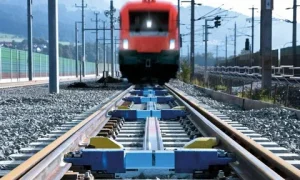
In the year 2025, the market for railway systems is expected to reach USD 31,057.9 million, and by 2035, it is projected to reach USD 47,772.5 million, growing at a CAGR of 4.4%. This steady growth trajectory reflects the global emphasis on sustainable transportation, rising investments in rail infrastructure, and the resurgence of passenger and freight rail services as viable alternatives to road and air transport. With increasing urbanization, congestion in roadways, and the need for cost-effective and energy-efficient transport options, governments across both developed and emerging economies are prioritizing railway modernization and expansion. From high-speed rail projects in Asia to freight rail electrification in Europe and smart rail networks in North America, the railway system market is experiencing strong momentum.
The integration of digital technologies, electrification, and automation into railway systems is reshaping the industry landscape. Smart signaling, predictive maintenance, and real-time traffic control are being adopted at scale to enhance safety and operational efficiency. At the same time, rising concerns over environmental sustainability are pushing countries to adopt electric and hybrid locomotives, reduce diesel reliance, and invest in green rail corridors. These combined technological and regulatory factors are opening up new opportunities across rolling stock, track systems, electrification infrastructure, and railway services.
Get Ahead with Our Report: Request Your Sample Now!
https://www.futuremarketinsights.com/reports/sample/rep-gb-16380
Key Takeaways
The railway system market is expanding in response to increasing global transportation demand and the need for sustainable, long-distance mobility solutions. Demand is particularly strong in densely populated urban centers, where metro rail, light rail, and commuter services are being rapidly deployed to address traffic congestion and carbon emissions. Electrification of railway lines is gaining prominence, especially in countries targeting net-zero emission goals. Modern rolling stock with improved passenger comfort, fuel efficiency, and digital connectivity is being adopted by national and private rail operators alike.
The freight rail sector is also witnessing growth due to its cost-effectiveness and ability to move large volumes with lower emissions compared to road transport. Integrated logistics hubs and multimodal connectivity are contributing to this shift, particularly in regions like North America and China. Furthermore, investment in rail automation and signaling is helping reduce human error, improve safety, and enable higher frequency operations in busy corridors. As a result, the railway system market is not only gaining in size but also in sophistication and strategic relevance.
Emerging Trends in the Global Market
One of the most prominent trends in the global railway system market is the rise of smart railway technologies. From Internet of Things (IoT)-enabled sensors for monitoring train health and track conditions to AI-based scheduling systems, the digitization of rail operations is transforming the efficiency, safety, and responsiveness of rail networks. Countries are increasingly focusing on intelligent transportation systems (ITS) to support predictive maintenance, reduce service interruptions, and optimize route planning.
Another emerging trend is the development of hydrogen-powered and battery-electric trains as alternatives to diesel locomotives, especially on non-electrified routes. These technologies align with global decarbonization efforts and offer long-term cost savings in maintenance and fuel expenditure. Additionally, high-speed rail development is accelerating, with major projects underway in Asia-Pacific and Europe. These systems are being designed to link major metropolitan areas, reduce travel times, and compete with short-haul air travel.
Significant Developments in the Global Sector: Trends and Opportunities in the Market
Recent years have seen a surge in public-private partnerships (PPPs) to fund and operate railway infrastructure projects. Governments are increasingly involving private players in the construction, maintenance, and service delivery of rail systems to leverage efficiency and innovation. Multilateral institutions such as the World Bank and Asian Infrastructure Investment Bank (AIIB) are funding large-scale rail projects in Africa, South Asia, and Latin America, creating significant opportunities for contractors, system providers, and service firms.
Urban metro systems are becoming a major growth area due to rising urban population and the need for clean, high-capacity transit. Many cities are implementing new subway lines, light rail networks, and mono-rail systems as part of broader smart city initiatives. At the same time, demand for rail maintenance and lifecycle services is increasing, as operators look to reduce downtime and improve asset utilization. Opportunities also lie in digital twins for rail networks, cybersecurity for signaling systems, and real-time passenger information platforms.
Recent Developments in the Market
In recent years, several key players have launched new-generation trains featuring enhanced energy efficiency, noise reduction, and intelligent automation capabilities. Rail companies are integrating advanced braking systems, driver assistance modules, and regenerative power systems into their rolling stock. Countries such as India, China, Germany, and the UK have rolled out significant high-speed rail projects and national electrification programs, boosting the market for signaling, traction, and substation technologies.
Investments in railway electrification, including high-voltage overhead lines and third-rail systems, are being ramped up to reduce the carbon footprint of national rail services. Meanwhile, automation of rail operations, such as unmanned metro lines and driverless trams, is gaining acceptance in densely populated cities, reducing operating costs and improving service frequency. Software platforms for rail asset management, ticketing, and passenger analytics are also becoming integral to modern rail systems.
Thorough Market Evaluation: Full Report
https://www.futuremarketinsights.com/reports/railway-system-market
Competition Outlook
The global railway system market is competitive and innovation-driven, featuring a mix of multinational corporations and regionally focused players. Leading firms are investing heavily in R&D to develop next-generation rail technologies, focusing on safety, reliability, and sustainability. Companies are also exploring international collaborations and strategic acquisitions to enhance their market footprint and gain access to emerging markets. Market players differentiate themselves through technology expertise, lifecycle services, and integrated transport solutions.
Key Players
Major players in the global railway system market include Siemens Mobility, Alstom SA, Hitachi Rail, CRRC Corporation Limited, Bombardier Transportation (now part of Alstom), Stadler Rail AG, Wabtec Corporation, Thales Group, Toshiba Infrastructure Systems & Solutions Corporation, and CAF (Construcciones y Auxiliar de Ferrocarriles). These companies are known for delivering comprehensive railway solutions, including rolling stock, signaling, electrification, and services for both passenger and freight applications.
Key Segmentations
The railway system market can be segmented by system type, application, and end use. By system type, the market includes electrification systems, signaling systems, communication systems, and train control systems. Electrification systems dominate the market due to the shift toward electric locomotives. By application, the market is divided into passenger transport and freight transport, with the former holding a larger share due to urban rail development. By end use, the market consists of original equipment manufacturers (OEMs) and aftermarket services, with OEMs currently leading due to ongoing rail infrastructure projects, although the aftermarket segment is expected to grow significantly over the next decade.
About Future Market Insights (FMI)
Future Market Insights, Inc. (ESOMAR certified, recipient of the Stevie Award, and a member of the Greater New York Chamber of Commerce) offers profound insights into the driving factors that are boosting demand in the market. FMI stands as the leading global provider of market intelligence, advisory services, consulting, and events for the Packaging, Food and Beverage, Consumer Technology, Healthcare, Industrial, and Chemicals markets. With a vast team of 400 analysts worldwide, FMI provides global, regional, and local expertise on diverse domains and industry trends across more than 110 countries.
Contact Us:
Future Market Insights Inc.
Christiana Corporate, 200 Continental Drive,
Suite 401, Newark, Delaware – 19713, USA
T: +1-845-579-5705
For Sales Enquiries: sales@futuremarketinsights.com
Website: https://www.futuremarketinsights.com
LinkedIn| Twitter| Blogs | YouTube