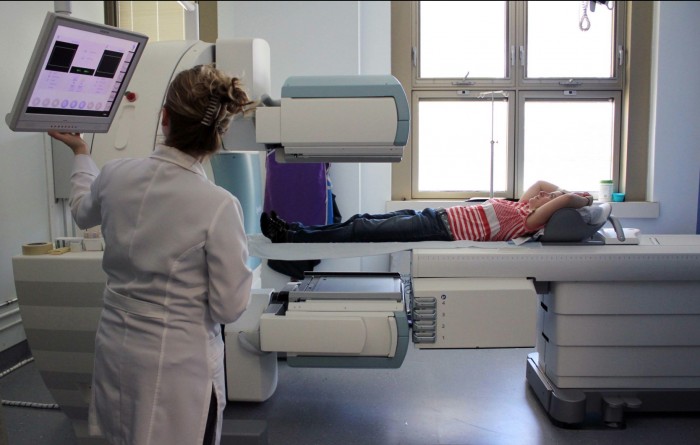
The mobile gamma cameras market is likely to remain growing through the coming decade due to rising demands for flexible, point-of-care diagnostic solutions. It is thought that the rise will go from a price of USD 64.6 billion in 2025 to USD 100.3 billion by 2035. This marks a growth rate of 4.5% for the years 2025 to 2035.
The mobile gamma cameras market is experiencing notable growth due to increasing applications in nuclear medicine and diagnostic imaging. These cameras, which are portable alternatives to traditional fixed gamma imaging systems, provide physicians with enhanced flexibility and real-time imaging capabilities. With advancements in technology, mobile gamma cameras are becoming more compact, efficient, and user-friendly, leading to their growing adoption across various medical facilities including hospitals, diagnostic centers, and ambulatory surgical units. This evolution aligns with the broader medical trend toward minimally invasive, on-the-go diagnostic procedures, enhancing the overall patient care experience.
As the demand for quick and accurate diagnostic tools rises, mobile gamma cameras are playing a critical role in the diagnosis and monitoring of diseases such as cancer, cardiovascular disorders, and neurological conditions. Their portability enables use at the patient’s bedside or in emergency situations, which proves invaluable in critical care scenarios. This increasing clinical reliance on portable imaging technology is set to expand the mobile gamma cameras market in the coming years.
Get Sample Report: – https://www.futuremarketinsights.com/reports/sample/rep-gb-7368
Market Trends
Several key trends are shaping the mobile gamma cameras market. A notable shift is the integration of advanced imaging technologies, such as solid-state detectors and artificial intelligence-based image enhancement tools. These improvements significantly increase the precision and efficiency of gamma imaging, offering clinicians more detailed and reliable diagnostic data.
Moreover, there is a growing trend of hybrid imaging systems, where mobile gamma cameras are being integrated with other diagnostic tools like SPECT and CT. These multimodal devices allow for a comprehensive assessment of a patient’s condition, boosting diagnostic confidence and treatment planning accuracy. Another emerging trend is the increased usage of mobile gamma cameras in outpatient and home care settings, enabled by their lightweight designs and wireless connectivity options.
In parallel, healthcare providers are increasingly focusing on value-based care. Mobile gamma cameras align with this goal by reducing the need for patient transfers, minimizing hospital stays, and optimizing workflow efficiency. This alignment with healthcare reform initiatives is expected to further drive adoption.
Driving Forces Behind Market Growth
Several drivers are contributing to the growth of the mobile gamma cameras market. First and foremost is the increasing prevalence of chronic diseases, particularly cancer and cardiac conditions, which require frequent and accurate diagnostic imaging. The aging global population also contributes to the rising demand for portable diagnostic tools, as older individuals are more prone to illnesses that require ongoing monitoring.
Technological advancements are another major driver. The development of compact, high-resolution detectors and user-friendly software has made mobile gamma cameras more appealing to medical practitioners. These innovations improve diagnostic capabilities while reducing the operational burden on healthcare staff.
The ongoing shift toward decentralized healthcare services is also fueling market expansion. Hospitals and clinics are embracing mobile solutions to enhance service delivery and reduce infrastructure costs. Furthermore, the COVID-19 pandemic highlighted the importance of mobile medical technologies, as many facilities sought to limit patient movement and contact. The lessons learned during the pandemic continue to influence healthcare strategies, promoting the use of portable imaging equipment.
Challenges and Opportunities
While the mobile gamma cameras market presents significant growth prospects, it is not without challenges. One major concern is the high cost of advanced mobile imaging systems, which can be a barrier for small and mid-sized healthcare providers. Limited reimbursement policies in certain regions further complicate the adoption of these devices.
There are also technical challenges related to image resolution and sensitivity, especially when compared to stationary imaging systems. Ensuring consistent image quality while maintaining portability remains a key concern for manufacturers. Additionally, the requirement for skilled professionals to operate and interpret mobile gamma imaging may limit its use in under-resourced areas.
Despite these challenges, the market offers numerous opportunities. Increasing healthcare investments in emerging economies are expected to create substantial demand for mobile diagnostic tools. Additionally, collaborations between medical device companies and research institutions are likely to spur the development of more cost-effective and efficient mobile gamma camera systems. These partnerships could accelerate innovation and expand market accessibility across different regions.
Recent Industry Developments
The mobile gamma cameras market has seen a range of significant developments in recent years. Companies are introducing next-generation cameras equipped with high-sensitivity detectors and real-time imaging capabilities. These advancements aim to improve diagnostic accuracy while reducing radiation exposure for patients.
There has also been a rise in partnerships and acquisitions among key industry players. These strategic collaborations are focused on expanding product portfolios and entering new geographical markets. Several companies are investing heavily in research and development to enhance the capabilities of their existing devices, while others are seeking regulatory approvals to broaden their reach in global markets.
Another notable development is the growing emphasis on software-driven imaging solutions. Many mobile gamma cameras now come integrated with machine learning algorithms that assist in image interpretation, reducing diagnostic errors and increasing clinical efficiency. These digital enhancements are becoming essential features that differentiate leading products in the market.
Regional Analysis
Regionally, North America currently leads the mobile gamma cameras market, driven by advanced healthcare infrastructure, high healthcare spending, and widespread adoption of cutting-edge medical technologies. The United States, in particular, holds a significant share due to its robust diagnostics ecosystem and growing emphasis on personalized medicine.
Europe follows closely, with strong demand in countries such as Germany, the UK, and France. Government initiatives promoting early disease detection and aging population demographics are key contributors to market growth in the region. Additionally, the presence of several prominent medical device manufacturers enhances market development.
Asia-Pacific is emerging as a high-growth region in the mobile gamma cameras market. Rapid economic development, rising healthcare investments, and increasing awareness of nuclear imaging techniques are driving demand in countries like China, India, and Japan. Furthermore, healthcare reforms and government support for medical technology adoption are likely to sustain long-term growth in this region.
Competitive Outlook
The mobile gamma cameras market is highly competitive, characterized by a mix of established players and emerging companies. Major firms are focusing on technological innovation, strategic partnerships, and geographic expansion to strengthen their market presence. Differentiation based on product features, such as portability, resolution, and integration capabilities, is a key strategy employed by market leaders.
R&D remains at the forefront of competitive strategies, with companies striving to develop next-generation cameras that deliver superior performance. Many are also investing in user interface improvements and AI-based diagnostic tools to enhance user experience and clinical utility. With regulatory landscapes evolving, market players are also placing greater emphasis on compliance and quality assurance.
The competition is expected to intensify as new entrants leverage digital technologies to disrupt traditional imaging models. However, companies with strong brand recognition, extensive distribution networks, and comprehensive service offerings are likely to maintain a competitive edge in the market.
Top Companies
Several key players dominate the mobile gamma cameras market, offering a broad range of products and services. These include GE Healthcare, Digirad Corporation, DDD-Diagnostic, Spectrum Dynamics, and Siemens Healthineers. These companies are known for their innovation, quality, and customer support, making them preferred partners for healthcare providers globally.
Digirad Corporation, for example, has built a reputation for its compact, high-performance mobile gamma cameras that are widely used in cardiology and oncology. GE Healthcare and Siemens Healthineers continue to lead through ongoing investments in advanced imaging technologies and AI integration. Meanwhile, companies like Spectrum Dynamics are pushing the boundaries of hybrid imaging solutions, combining mobility with multimodal functionality.
These companies are also increasingly focusing on sustainability and cost-efficiency, introducing energy-efficient devices and offering flexible financing options to broaden market access.
Explore In-Depth Analysis-Click Here to Access the Report:- https://www.futuremarketinsights.com/reports/mobile-gamma-cameras-market
Segmentation Outlook
The mobile gamma cameras market can be segmented by product type, application, end-user, and region. By product type, the market includes single-head, dual-head, and triple-head cameras. Single-head cameras remain the most widely used due to their cost-effectiveness and compact design, while dual and triple-head systems offer enhanced imaging speed and accuracy.
In terms of application, cardiology, oncology, and neurology are the primary segments driving market demand. Cardiology holds the largest share, thanks to the growing need for mobile imaging in the diagnosis of coronary artery diseases and heart failure. Oncology is also a rapidly growing segment, as gamma imaging plays a vital role in tumor detection and monitoring treatment response.
By end-user, hospitals dominate the market, followed by diagnostic centers and ambulatory surgical centers. However, home healthcare and mobile diagnostic units are gaining traction, reflecting the broader trend toward patient-centric care models.
About Future Market Insights (FMI)
Future Market Insights, Inc. (ESOMAR certified, recipient of the Stevie Award, and a member of the Greater New York Chamber of Commerce) offers profound insights into the driving factors that are boosting demand in the market. FMI stands as the leading global provider of market intelligence, advisory services, consulting, and events for the Packaging, Food and Beverage, Consumer Technology, Healthcare, Industrial, and Chemicals markets. With a vast team of over 400 analysts worldwide, FMI provides global, regional, and local expertise on diverse domains and industry trends across more than 110 countries.
Contact Us:
Future Market Insights Inc.
Christiana Corporate, 200 Continental Drive,
Suite 401, Newark, Delaware – 19713, USA
T: +1-347-918-3531
For Sales Enquiries: sales@futuremarketinsights.com
Website: https://www.futuremarketinsights.com
LinkedIn| Twitter| Blogs | YouTube