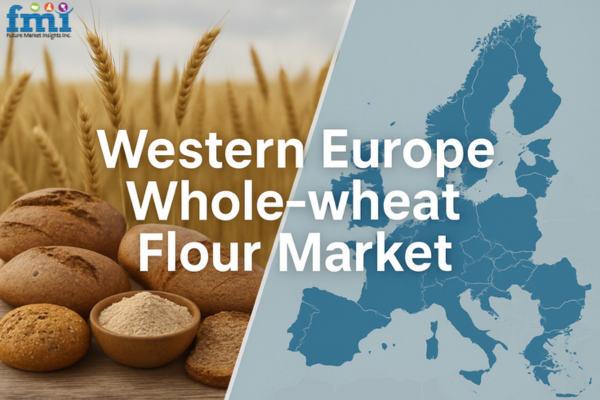
The Western Europe whole-wheat flour market is on a solid growth trajectory, projected to reach a valuation of USD 9.5 billion in 2025. Over the forecast period from 2025 to 2035, the market is expected to expand at a CAGR of 4.8%, culminating in a total market size of USD 15.2 billion by 2035. This growth reflects the region’s rising emphasis on healthy eating habits, clean-label products, and high-fiber diets. Consumer preferences are rapidly shifting toward minimally processed and whole-grain alternatives, positioning whole-wheat flour as a critical staple in both household kitchens and commercial food applications.
The surge in demand is further underpinned by increasing public awareness regarding the nutritional advantages of whole grains. As individuals across Western Europe become more health-conscious, there is a growing preference for ingredients that support overall wellness. Whole-wheat flour, rich in fiber, B vitamins, antioxidants, and micronutrients, is witnessing a robust surge in demand across bakery, snacks, pasta, and ready-to-eat food categories. This trend is reinforced by public health campaigns promoting healthy diets and a significant uptick in the number of consumers actively seeking clean-label and organic food options.
Your Guide to Market Intelligence – Download a Sample Copy: https://www.futuremarketinsights.com/reports/sample/rep-gb-18587
Key Takeaways:
- Market Valuation: Expected to reach USD 9.5 billion in 2025 and USD 15.2 billion by 2035.
- Growth Rate: Anticipated CAGR of 4.8% between 2025 and 2035.
- Key Driver: Increasing consumer demand for health-centric and high-fiber food products.
- Dominant Segments: Bakery applications continue to lead, with emerging demand in RTE meals and snack foods.
- Leading Countries: Germany, France, and the UK contribute significantly to regional market share.
Market Dynamics
Drivers:
A primary growth catalyst for the Western Europe whole-wheat flour market is the shift in consumer eating habits toward healthier and more balanced diets. With a growing understanding of the health benefits of whole grains—such as improved digestion, lower cholesterol levels, and sustained energy—consumers are increasingly incorporating whole-wheat flour into their daily meals. The popularity of plant-based, organic, and high-fiber diets further propels this trend.
Restraints:
Despite growing demand, market expansion is somewhat hindered by higher production costs compared to refined wheat flour. Whole-wheat flour has a shorter shelf life due to the presence of natural oils in the bran and germ, which can limit its widespread adoption in certain food processing applications.
Opportunities:
Innovations in food processing, improved shelf-life technology, and increased availability of fortified and organic whole-wheat flour present lucrative opportunities for market players. Additionally, the growing preference for sustainable and environmentally friendly farming practices is supporting the adoption of whole-wheat flour sourced from organic and regenerative agriculture.
Recent Developments in the Market
- Product Innovation: Several regional players have introduced enriched and organic variants of whole-wheat flour, catering to niche health-conscious consumer segments.
- Retail Expansion: Supermarkets and e-commerce platforms across Western Europe are expanding their organic and clean-label product offerings, increasing visibility and access to premium whole-wheat flour.
- Government Campaigns: National dietary guidelines and public awareness campaigns in countries like the UK and Germany are actively promoting whole grain consumption as part of healthy lifestyle initiatives.
Key Benefits for Stakeholders
- Manufacturers: Stand to gain from product innovation in fortified and specialty flours catering to targeted dietary needs.
- Retailers: Benefit from the increased footfall in health and wellness segments, as well as expanding online grocery demand.
- Consumers: Enjoy access to healthier food options with enhanced nutritional profiles.
- Policy Makers: Gain insights into encouraging healthier dietary habits and reducing healthcare burdens related to lifestyle diseases.
Stay Ahead with the Complete Market Analysis – Download Full Report: https://www.futuremarketinsights.com/reports/whole-wheat-flour-industry-analysis-in-western-europe
Competitive Analysis
The Western Europe whole-wheat flour market is moderately consolidated, with a mix of multinational corporations and regional producers competing on price, quality, and product differentiation. Key players are emphasizing organic sourcing, non-GMO labeling, and sustainability certifications to stand out in a competitive landscape.
- Market Leaders: Prominent players are investing in eco-friendly packaging and clean-label certification to enhance brand trust.
- M&A Activity: Strategic mergers and acquisitions have been observed, particularly aimed at expanding product portfolios and strengthening distribution networks.
- Private Labels: Retail chains are increasingly introducing private-label whole-wheat flour products at competitive pricing, posing a challenge to established brands.
Top Segments Studied in the Western Europe Whole-wheat Flour Market
By Product Type:
In terms of product type, the market is divided into pancake flour, bread flour, pizza flour, and cracker flour.
By Nature:
With respect to nature, the industry is bifurcated into organic and conventional.
By Application:
Based on application, the market is divided into bakery products, bread, biscuits, buns, rolls, cookies, sweet goods, desserts, tortillas.
By Packaging:
Based on packaging, the industry is classified into bags, super sacks, and bulk tankers.
By Sales Channel:
Based on sales channel, the market is divided into direct sales/B2B, indirect sales/B2C, supermarket/hypermarket, retail stores, specialty stores, general grocery stores, and online stores.
By Country:
By country, the industry is segregated into the UK, Germany, Italy, France, Spain, and the rest of Europe.
About Future Market Insights (FMI)
Future Market Insights, Inc. (ESOMAR certified, recipient of the Stevie Award, and a member of the Greater New York Chamber of Commerce) offers profound insights into the driving factors that are boosting demand in the market. FMI stands as the leading global provider of market intelligence, advisory services, consulting, and events for the Packaging, Food and Beverage, Consumer Technology, Healthcare, Industrial, and Chemicals markets. With a vast team of over 400 analysts worldwide, FMI provides global, regional, and local expertise on diverse domains and industry trends across more than 110 countries.
Contact Us:
Future Market Insights Inc.
Christiana Corporate, 200 Continental Drive,
Suite 401, Newark, Delaware – 19713, USA
T: +1-347-918-3531
For Sales Enquiries: sales@futuremarketinsights.com
Website: https://www.futuremarketinsights.com
LinkedIn| Twitter| Blogs | YouTube