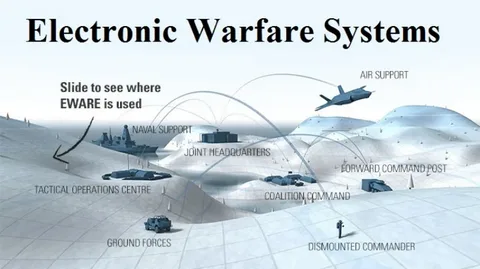
Increasing demand for advanced defense technologies and rising geopolitical tensions will propel the industry to be an even more dominant force in the coming years. Between 2025 and 2035, the electronic warfare market is projected to grow at a CAGR of 5.5%, from a valuation of USD 20.7 billion in 2025 and is expected to grow to USD 35.8 billion by 2035.
The electronic warfare market is emerging as a cornerstone of modern military strategy, shaped by rapid technological advancements and the growing sophistication of global threats. In today’s digitally-driven battlefields, the importance of electronic warfare (EW) cannot be overstated. It encompasses the strategic use of the electromagnetic spectrum to sense, disrupt, or control an adversary’s electronic systems while protecting one’s own. Governments and defense organizations worldwide are heavily investing in electronic warfare capabilities to strengthen their national security and maintain strategic superiority.
Get Sample Report: – https://www.futuremarketinsights.com/reports/sample/rep-gb-1806
The electronic warfare market spans various sectors including defense, aerospace, homeland security, and even cyber intelligence. EW systems are designed to support missions that involve surveillance, threat detection, countermeasures, and command-and-control disruption. The market is expanding with the integration of artificial intelligence, machine learning, and next-generation radar technologies, making EW systems more accurate, responsive, and autonomous. With rising geopolitical tensions and the escalating threat of asymmetric warfare, the demand for advanced electronic warfare solutions continues to increase.
Market Trends
Several transformative trends are currently shaping the electronic warfare market. One notable trend is the miniaturization of EW systems, making them more adaptable for deployment on smaller platforms such as unmanned aerial vehicles (UAVs), ships, and ground-based systems. Furthermore, there is a significant shift toward multi-domain operations where EW capabilities are integrated across land, sea, air, space, and cyber environments.
Another trend is the development of cognitive electronic warfare systems that use AI to rapidly analyze threats and determine optimal countermeasures in real-time. These smart systems are capable of learning from past encounters and evolving tactics accordingly, offering a strategic edge in electronic engagements. In addition, open architecture systems are gaining popularity, enabling interoperability among various EW components from different manufacturers and reducing long-term costs.
Driving Forces Behind Market Growth
Several key drivers are propelling the growth of the electronic warfare market. First and foremost is the increasing number of regional conflicts and global security concerns. With nations seeking to fortify their defense mechanisms, electronic warfare systems are being prioritized in defense budgets.
The proliferation of advanced communication technologies and network-centric warfare has also contributed to this growth. As modern military operations rely heavily on real-time data and seamless communication, protecting these networks from jamming, interception, and manipulation becomes crucial. This necessitates the adoption of robust EW solutions.
Technological innovations are another significant driver. Continuous advancements in sensors, signal processing, and electromagnetic spectrum management are pushing the boundaries of what EW systems can achieve. These innovations enhance both offensive and defensive capabilities, driving widespread adoption across various military and security domains.
Challenges and Opportunities
While the electronic warfare market is growing, it faces certain challenges that could potentially hinder its progress. One such challenge is the high cost of development and implementation. Developing sophisticated EW systems involves extensive R&D and advanced manufacturing, which can strain the budgets of even the most developed nations.
Another challenge is the complexity of integrating EW systems with existing military infrastructure. Legacy systems often lack compatibility with modern digital technologies, creating a need for substantial upgrades and retrofits.
Despite these challenges, the market presents significant opportunities. The rise in cyber warfare has opened new avenues for EW applications, particularly in the area of cyber-electromagnetic activities. In addition, developing nations are increasingly investing in modernizing their defense capabilities, creating lucrative opportunities for EW manufacturers and service providers.
Recent Industry Developments
- The electronic warfare market has witnessed a wave of strategic developments in recent years. Leading defense contractors are entering into collaborations and partnerships to co-develop next-generation EW solutions. Many of these collaborations aim to leverage AI and machine learning to enhance the functionality of EW systems.
- Furthermore, governments are launching initiatives to bolster domestic EW capabilities. For example, several defense ministries have announced funding for EW research programs and infrastructure upgrades to enhance their strategic capabilities. Additionally, there has been an uptick in EW-focused military exercises that test the interoperability and effectiveness of new technologies under simulated combat conditions.
Regional Analysis
Regionally, the electronic warfare market demonstrates varying levels of growth and investment. North America, led by the United States, dominates the market due to substantial defense spending and technological leadership. The U.S. Department of Defense continues to prioritize EW programs, investing heavily in cutting-edge research and operational testing.
Europe is also a significant player, with countries like the United Kingdom, France, and Germany ramping up their EW capabilities in response to rising regional threats. The region benefits from strong industrial collaboration and shared defense initiatives under the NATO umbrella.
The Asia-Pacific region is experiencing rapid growth in the electronic warfare market. Countries such as China, India, Japan, and South Korea are modernizing their military forces and increasing their defense expenditures. Regional tensions and the push for technological self-reliance are driving substantial investments in indigenous EW development.
The Middle East and Africa, although smaller in market size, are showing increasing interest in EW systems to counter regional insurgencies and secure critical infrastructure. Latin America, while still nascent, is slowly adopting EW technologies as part of broader defense modernization efforts.
Competitive Outlook
The electronic warfare market is characterized by intense competition and rapid innovation. Major players are focusing on product differentiation through technological advancements, strategic partnerships, and acquisition of specialized firms. The competitive landscape is further shaped by defense contracts, with companies vying for long-term agreements with government agencies and armed forces.
To maintain a competitive edge, companies are also expanding their global presence and investing in local production facilities in high-growth regions. Emphasis is being placed on scalable and modular systems that can be customized to specific mission requirements. Moreover, there is a growing trend of integrating cyber capabilities with traditional EW systems to offer a more comprehensive threat response.
Explore In-Depth Analysis-Click Here to Access the Report:- https://www.futuremarketinsights.com/reports/electronic-warfare-market
Top Companies
Several key players dominate the electronic warfare market, each contributing to innovation and market expansion. Lockheed Martin, Northrop Grumman, Raytheon Technologies, BAE Systems, and L3Harris Technologies are among the global leaders, offering a wide range of EW solutions tailored for air, land, and sea platforms.
Other notable companies include Saab AB, Elbit Systems, Thales Group, Leonardo S.p.A., and Cobham. These companies invest heavily in R&D and maintain a strong presence in international markets. Their extensive portfolios cover electronic support measures, electronic attack systems, and electronic protection technologies.
Emerging firms are also making their mark by offering niche capabilities and specialized technologies. These smaller players often collaborate with defense ministries or larger corporations to accelerate development and deployment of innovative solutions.
Segmentation Outlook
The electronic warfare market can be segmented based on capabilities, platforms, and end-users. By capability, the market includes electronic attack, electronic protection, and electronic support. Electronic attack systems, such as jammers and spoofers, are in high demand for disabling enemy communications and radar. Electronic protection systems ensure the resilience and operability of friendly assets in contested environments, while electronic support involves threat detection and spectrum monitoring.
By platform, the market is divided into airborne, naval, ground-based, and space-based systems. Airborne EW systems are widely used for both strategic and tactical missions, while naval and ground-based systems play a crucial role in homeland security and maritime operations. Space-based EW capabilities are gaining prominence due to the increasing militarization of space.
In terms of end-users, the primary segments are defense and homeland security. However, there is a growing interest from the commercial aviation and critical infrastructure sectors, particularly in protecting assets from GPS jamming and cyber-physical threats.
About Future Market Insights (FMI)
Future Market Insights, Inc. (ESOMAR certified, recipient of the Stevie Award, and a member of the Greater New York Chamber of Commerce) offers profound insights into the driving factors that are boosting demand in the market. FMI stands as the leading global provider of market intelligence, advisory services, consulting, and events for the Packaging, Food and Beverage, Consumer Technology, Healthcare, Industrial, and Chemicals markets. With a vast team of over 400 analysts worldwide, FMI provides global, regional, and local expertise on diverse domains and industry trends across more than 110 countries.
Contact Us:
Future Market Insights Inc.
Christiana Corporate, 200 Continental Drive,
Suite 401, Newark, Delaware – 19713, USA
T: +1-347-918-3531
For Sales Enquiries: sales@futuremarketinsights.com
Website: https://www.futuremarketinsights.com
LinkedIn| Twitter| Blogs | YouTube