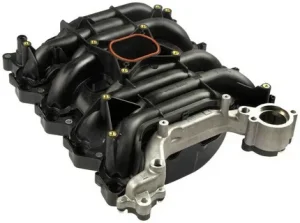
The global automotive intake manifold market is poised for steady growth between 2025 and 2035, driven by increasing vehicle production, advancements in fuel efficiency technologies, and the growing adoption of lightweight materials in engine components. The market is projected to reach USD 34,787.0 million in 2025 and expand to USD 54,478.3 million by 2035, reflecting a compound annual growth rate (CAGR) of 4.6% over the forecast period. This expansion is largely attributed to the rising demand for high-performance engines and stringent emission norms, which are encouraging automotive manufacturers to develop optimized air-fuel mixture systems, of which the intake manifold is a critical component.
Moreover, the transition toward electric and hybrid vehicles has not dampened the market’s prospects, as intake manifolds remain essential for the internal combustion engines used in hybrid models. Additionally, the development of advanced materials such as composites and aluminum for intake manifold construction has enabled improved engine performance and reduced vehicle weight. These benefits align with industry goals for fuel economy and emissions reduction, thus reinforcing the market’s long-term outlook.
Get Ahead with Our Report: Request Your Sample Now!
https://www.futuremarketinsights.com/reports/sample/rep-gb-2887
Key Takeaways
The global automotive intake manifold market will experience consistent growth from 2025 to 2035, supported by a CAGR of 4.6%. The market size is expected to expand from USD 34.8 billion in 2025 to USD 54.5 billion by 2035. A significant driver includes the growing global vehicle fleet and the production of fuel-efficient vehicles. The increasing use of advanced materials like aluminum and composites enhances thermal resistance and strength, improving engine efficiency and lowering emissions. The surge in hybrid vehicle sales will sustain demand for advanced intake manifold systems, particularly in regions enforcing strict carbon emission regulations.
Emerging Trends in the Global Market
A major trend in the market is the widespread shift from cast iron to plastic and composite intake manifolds. These materials offer superior weight reduction and design flexibility while maintaining structural integrity. Additionally, manufacturers are focusing on integrating variable intake manifold technologies to optimize airflow, thereby boosting engine performance across different speed ranges. The increasing integration of simulation and 3D printing technologies in intake manifold design is also streamlining prototyping and reducing time-to-market.
Further, the integration of active air control systems within intake manifolds is gaining traction. These systems adjust airflow based on engine load and speed, which helps enhance power output and fuel economy. This trend is being increasingly adopted in passenger cars and light commercial vehicles, particularly in developed regions such as North America and Western Europe.
Significant Developments in the Global Sector: Trends and Opportunities in the Market
Automotive manufacturers are aggressively investing in R&D to develop lighter, more durable intake manifolds that align with emission standards set by governments across the globe. This includes the adoption of thermoplastic materials with reinforced fiber compositions. As engine downsizing becomes a prominent strategy to reduce emissions without compromising performance, the demand for highly efficient and compact intake manifolds is expected to grow. Opportunities are also emerging in developing regions such as Asia-Pacific and Latin America, where increasing middle-class income and rapid urbanization are fueling vehicle sales.
Another opportunity lies in the aftermarket segment, where the replacement of old or faulty intake manifolds presents a recurring revenue stream. Moreover, as modern intake manifolds become more complex and integrated with electronic systems, demand for specialized and high-performance components in premium and sports vehicles is likely to rise. Companies offering modular and customizable manifold solutions are well-positioned to tap into these growing opportunities.
Recent Developments in the Market
Recent years have witnessed several strategic initiatives aimed at strengthening product offerings and expanding market reach. Companies are entering into partnerships and joint ventures with OEMs to co-develop intake systems tailored to new engine architectures. There has also been a rise in mergers and acquisitions, especially among Tier 1 and Tier 2 suppliers, to consolidate capabilities and expand geographical presence.
In 2024, several players introduced intake manifolds with integrated sensors and actuators to enable real-time monitoring and dynamic control of air intake. These innovations are expected to gain traction in next-generation vehicles. Moreover, automakers in China and India have announced plans to localize production of high-performance intake manifolds, driven by government incentives and the push for self-reliance in the auto component supply chain.
Exhaustive Market Report: A Complete Study
https://www.futuremarketinsights.com/reports/automotive-intake-manifold-market
Competition Outlook
The automotive intake manifold market is moderately fragmented, with key players focusing on innovation, cost efficiency, and strategic alliances to strengthen their competitive edge. Leading companies include MAHLE GmbH, Mann+Hummel Group, Röchling Group, Donaldson Company Inc., and Aisin Corporation. These players are continuously investing in material science and design engineering to create next-generation manifolds that can withstand higher pressures and temperatures in modern engines.
Emerging players from Asia-Pacific, especially from China and South Korea, are entering the market with competitive pricing and localized manufacturing capabilities. Established companies are responding by expanding their production footprint in cost-effective regions and leveraging digital manufacturing to streamline operations.
Key Segmentations
The market is segmented by material type, vehicle type, manifold type, and region. By material, aluminum and plastic composites dominate due to their favorable weight-to-strength ratio. By vehicle type, passenger cars hold the largest share, followed by light commercial vehicles. Based on manifold type, the market is segmented into single-plane and dual-plane manifolds, with dual-plane variants gaining popularity in performance engines. Regionally, Asia-Pacific leads the market, followed by North America and Europe, driven by high vehicle production and increasing adoption of emission control technologies.
About Future Market Insights (FMI)
Future Market Insights, Inc. (ESOMAR certified, recipient of the Stevie Award, and a member of the Greater New York Chamber of Commerce) offers profound insights into the driving factors that are boosting demand in the market. FMI stands as the leading global provider of market intelligence, advisory services, consulting, and events for the Packaging, Food and Beverage, Consumer Technology, Healthcare, Industrial, and Chemicals markets. With a vast team of 400 analysts worldwide, FMI provides global, regional, and local expertise on diverse domains and industry trends across more than 110 countries.
Contact Us:
Future Market Insights Inc.
Christiana Corporate, 200 Continental Drive,
Suite 401, Newark, Delaware – 19713, USA
T: +1-845-579-5705
For Sales Enquiries: sales@futuremarketinsights.com
Website: https://www.futuremarketinsights.com
LinkedIn| Twitter| Blogs | YouTube